Showing posts with label Afghanistan. Show all posts

December 09, 2016

Friday Round Up - 9th December, 2016

This week on Photojournalism Now: Friday Round Up Stephen Dupont's Generation AK reviewed, Out of the Phone launches a new publishing platform for mobile photographers, plus links to Daniel Berehulak's brilliant photo essay and article on the Philippines savage anti drug campaign and the winners of Lensculture's Emerging Talent 2016.

Book review: Stephen Dupont 
Generation AK The Afghanistan Wars 1993-2012


I would that my photographs might be, not the coverage of a news event, but an indictment of war - the brutal corrupting viciousness of its doing to the minds and bodies of men; and, that my photographs might be a powerful emotional catalyst to the reasoning which would help this vile and criminal stupidity from beginning again. W. Eugene Smith.

This quote from W. Eugene Smith appears at the beginning of Stephen Dupont's opus on Afghanistan, which is a heavy tome in every sense of the word. But don't let that deter you as this is a story that needs to be told, needs to be looked at. What we know of Afghanistan is largely influenced by what we see on the nightly news and in newspapers and magazines. But these snapshots can't give an insight into the country and its people the way Dupont's 20 year study does.


Generation AK is sectioned into chapters each of which begin with diary entries from Dupont. Words and pictures need each other and Dupont's reminiscing helps to draw the reader into the photographer's world, albeit if only in our imagination because if you haven't done it, you cannot really imagine what it must be like to submerge yourself in a war zone. To do so voluntarily is another story altogether. But without photographers like Dupont these stories would never be told.

Dupont has an engaging storytelling manner, and his words sweep you along in the drama. As you move through the first chapter, The Civil War 1993-2001, the sounds of rockets exploding and bullets screaming overhead become an inner soundtrack to the anxiety riddled faces of the people who came under Dupont's gaze.

In the chapter on the guerrilla leader Ahmed Shah Massoud, Dupont tells how when he was travelling to meet Massoud he shared a helicopter ride with a dead Afghan General, the aircraft filled with the smell of "rotting flesh, formaldehyde and diesel fumes." My nose twitches with the suggestion, but the thought is quickly replaced by the force of the images, which capture Massoud with his followers as well as in quiet, reflective moments that make you wonder what this man who was idolised by his followers was really like.


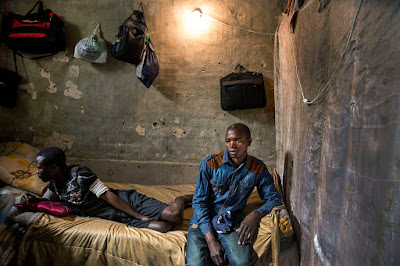
Dupont's series Stoned in Kabul, where he followed two heroin addicted brothers Reza and Hussein, is also featured in Generation AK. I've seen this work in exhibition and it's truly startling, raw and unnerving, reflecting the savagery and desperate nature of life on the streets of Kabul.


The series Axe Me Biggie (explained as "a crude Anglo phonetic rendering of the Dari for Mister, take my picture") also features. Dupont shot these pictures in a three hour window on the streets of Kabul. The series comprises 18 portraits of Afghans photographed in front of a piece of black fabric rigged up to create a makeshift studio. These portraits say 'take my picture, let people see me, let people know that I am not defeated, let me look you in the eye and tell you my story'.


I first interviewed Dupont in 2008 not long after he had returned from Afghanistan where he'd narrowly missed being blown to pieces in a suicide bombing. He'd been travelling with a poppy eradication unit. In the book Dupont gives an account of that day and how he was operating on auto-pilot as he shot and filmed the scene, in which fellow Australian journalist Paul Raffaele was seriously injured. The pictures leave the viewer with little doubt that Dupont was lucky to have escaped this tour with his life.

Generation AK is a book that requires time to look at otherwise it become too overwhelming and the story gets lost in the horror of war. Dupont is a master storyteller. He knows how to build the pace, to combine images that convey a narrative that is complex yet accessible.

It always feels odd to talk about aesthetics when the subject matter is so grim, but this is a beautiful book and the reproduction of images in both black & white and colour is superb, which is what you would expect from Steidl. The book features a foreword written by Jacques Menasche.

When I look at Dupont's work the overriding emotion I feel is respect. Respect for this photographer who is driven to tell these amazing stories often at great personal risk and cost. And respect for the human spirit and the will to survive even in the face of untold horrors.

This is important work. Don't look away.

To buy the book visit Steidl 
To see more of Stephen Dupont's work visit his website

On-Demand Books:
Out of the Phone Publishing


While we're talking about books, for those who can't get a deal with the likes of Steidl, or who just want to get their pictures off their phone and onto paper, Paris publishing house Out of the Phone (OOTP) has come up with a print-on-demand book idea that allows photographers to produce inexpensive books that are quirky and personal.


The first OOTP print-on-demand photo book is a travel notebook with a specific format and pagination that allows you to present up to 50 pictures. Produced in France, the travel notebook has an artisanal look and feel. Founder of OOTP Pierre Le Govic is hoping to raise funds on Indiegogo to build a website for what he is calling the 'world's first print-on-demand photo book platform for mobile photographers'. If you’re interested, take a look here.  

Weekend Reading: 

New York Times


More amazing work by Pulitzer Prize winning photojournalist Australian Daniel Berehulak on the savage anti-drug campaign being waged in the Philippines where Berehulak documented 57 homicide victims over 35 days. Berehulak photographed and wrote the story for the New York Times. Here's an excerpt: 

“The rain-soaked alley in the Pasay district of Manila was my 17th crime scene, on my 11th day in the Philippines capital. I had come to document the bloody and chaotic campaign against drugs that President Rodrigo Duterte began when he took office on June 30: since then, about 2000 people had been slain at the hands of the police alone….”

Awards:
Lensculture 2016 Emerging Talent


Check out the top 50 in this year's Lensculture Emerging Talent competition, including Polish photographer Wiktoria Wojciechowska who I met at Paris Photo last year. She was one of eight in the Jurors's pick for her body of work, Sparks, which she describes as 'a multifaceted portrait of a contemporary war', in this case the conflict in Ukraine. 

The gold leaf depicts those who didn't make it home

September 02, 2016

Friday Round Up - 2nd September, 2016

This week on Photojournalism Now: Friday Round Up part two of the Visa pour l'Image special with work from Peter Bauza, David Guttenfelder, Andrew Quilty, winner of the Ville de Perpignan Rémi Ochlik Award - 2016 Niels Ackermann and Winner of the Humanitarian Visa d’or award – International Committee of the Red Cross (ICRC) 2016 Juan Arredondo. Also the winners of the Getty Grants and some cool book signings happening Friday afternoon, so get down to La Poudrière: Rue Rabelais if you're in Perpignan.

Special Feature:
Visa Pour L'Image - Part Two


Exhibitions

Peter Bauza
Echo Photojournalism

Maria Eduarda (12) lives in one of the five unfinished buildings of what should have been a middle-class condominium. The site where 300 families have found shelter is near Rio de Janeiro, but far from the public gaze. © Peter Bauza / Echo Photojournalism


Maria Eduarda in the bedroom she shares with four siblings. © Peter Bauza / Echo Photojournalism

David Guttenfelder
Coming Home

 An old tank is now a swimming pool on the farm. Van Meter, Iowa, USA. © David Guttenfelder


North Korean veterans of the Korean War entering a cemetery for fellow veterans during a ceremony to mark the 60th anniversary of the armistice ending hostilities on the Korean peninsula. Pyongyang, North Korea, July 24, 2013. © David Guttenfelder / Associated Press

Andrew Quilty
Afghanistan: After Enduring Freedom

Afghan National Army officers resting during a clearing operation in the final days of the counter-offensive by government forces to retake Kunduz City from Taliban insurgents. October 10, 2015.
© Andrew Quilty / Agence VU’


 A baby girl who suffered burns from an oil heater at home. Boost Hospital, Lashkar Gah (capital of Helmand Province), Afghanistan. February, 2014. © Andrew Quilty / Agence VU’


A mother with her daughter waiting for emergency treatment. Boost Hospital, Lashkar Gah (capital of Helmand Province), Afghanistan. February, 2014. © Andrew Quilty / Agence VU’

Niels Ackermann
Winner of the Ville de Perpignan Rémi Ochlik Award - 2016

Employees of a local TV and internet provider (Maket) during the city’s annual day celebration.
Slavutych, Ukraine, June 1, 2013 © Niels Ackermann / Lundi13


 Zhenya and Yulia with their witnesses, Irina and Artiom, at their wedding ceremony in the City Hall.Slavutych, Ukraine, June 1, 2013 © Niels Ackermann / Lundi13


In a playground in one of the neighborhoods in the city. Slavutych, Ukraine 2012 © Niels Ackermann / Lundi13

Juan Arredondo
Winner of the Humanitarian Visa d’or award – International Committee of the Red Cross (ICRC) 2016


A father carrying the coffin of his son killed by FARC forces (46th front) as the indigenous community of Tortugaña Telembi walks through the mountains to bury 11 of their members accused by FARC of aiding the Colombian Army, including two young boys who deserted. Bellavista, Nariño, November 12, 2014. © Juan Arredondo / Getty Images Reportage 


 A field trip to the city for former child soldiers taking part in a government program to help them return to civilian life. Manizales, March 31, 2015. © Juan Arredondo / Getty Images Reportage 


Members of the ELN (Ejercito de Liberación Nacional) at their camp. A quarter to half of child combatants are girls. Chocó, Colombia, February 17, 2014. © Juan Arredondo / Getty Images Reportage 
 
Awards:
Getty Images Grants for Editorial Photography

This years recipients of Getty Images’ annual Grants for Editorial Photography programme were announced last night at Visa. Congratulations to the five photojournalists:

Sergey Ponomarev for Exodus, a project which explores the migrants and refugees of the Middle East and Africa.


Katie Orlinsky
for Chasing Winter, which examines the effects of climate change in Alaska. 

 
Mary F. Calvert
for Prisoners of War: Male-on-male Rape in America’s Military, a body of work that documents American military rape survivors who are forced out of service.


Jonathan Torgovnik for The ‘Hijacked Life’ of African Migrants in Johannesburg, a project which examines the complex issues faced by migrants from the African continent upon arrival in South Africa. 


Kirsten Luce receives the David Laidler Memorial Award for Border Security. Her project, captured in the southernmost point of Texas, examines the busiest corridor for human and drug trafficking in the US. 


Each receives a grant of US$10,000, as well as collaborative editorial support from Getty Images.

ANI-PrixPalace Award:

Australian-based Dutch photographer Ingetje Tadros has won this year's Ani-PrixPalace Award for her work This is My Country, a visual documentation of Australia’s indigenous people. It communicates the legacy of historical domination and oppression of Australia’s first inhabitants within a contemporary context.

BOOK SIGNINGS AT VISA:

This is My Country
Ingetje Tadros
Signing: September 2nd at 3 pm at La Poudrière: Rue Rabelais, Perpignan

Ingetje Tadros’s, This is My Country is a compelling book, which takes an in depth look at the indigenous community of Kennedy Hill, in Broome, Western Australia, a people balanced on the precipice of life, who for the most part are disenfranchised, neglected, and often forgotten.

Ingetje has won numerous awards for this body of work including the Walkley Award for Excellence in Photojournalism - Feature Photographic Essay - 2015; the Amnesty International Media Award 2015, photography; Best Feature Photographic Essay at the West Australian Media Awards 2015; the Exposure Award, digital display at The Louvre in Paris 2015.

Talibes Modern Day Slaves
Mario Cruz

Signing: September 2nd at 3 pm at La Poudrière: Rue Rabelais, Perpignan

Mario Cruz gained rare access to the dark side of many darras (Koranic schools) in Senegal and captured disturbing but stunning photographs of the lives of young boys subjected to slave-like conditions. The book Talibes Modern Day Slaves documents an alarming development among the darras that impacts at least 50,000 young boys in Senegal, aged between five and 15.

The work received the 2016 World Press Photo Award for Contemporary Issues and was a finalist for the 2016 FotoEvidence Book Award.

Afghanistan: Between Hope and Fear
Paula Bronstein
Signing: September 2nd at 4 pm at La Poudrière: Rue Rabelais, Perpignan
World-acclaimed photojournalist Paula Bronstein presents a photographic portrait of this war-torn country’s people across more than a decade. With empathy born of the challenges of being an American female photojournalist working in a conservative Islamic country, Paula gives voice to those Afghans, particularly women and children, rendered silent during the violent Taliban regime.

May 27, 2016

Friday Round Up - 27th May, 2016

Exclusive to Photojournalism Now: 
This week legendary photojournalist Tim Page returns to Photojournalism Now with "Afghanistan from the Air" a series of unpublished photographs accompanied by a story written by Tim about his time in that country.

In exclusive monthly installations, Tim will showcase images from his vast archive and share his experiences with Photojournalism Now's readers.

This is a fantastic opportunity for Tim to publish work that is beyond the scope of conflict photojournalism, the genre in which he made his name.

I'm delighted to be able to feature these images and excited about the installations to come.

Tim's archive is amazing.

Just wait and see!

Alison Stieven-Taylor
May 2016

Special Feature:
AFGHANISTAN FROM THE AIR

Words and Pictures: Tim Page


Afghanistan is a brutal place, the landscape as rugged as the folk that live on a land that is only 12% arable.

It is the collision and collusion of east and west and its mountains, the Hindu Kush rise up across its entirety.

In between are sparse bits of green clinging to riversides in gorges or dusty plains.

Now and then a broad lush valley appears between ranges where war has ravaged much of the countryside over the last 40 years.

This magical land is difficult to see from its beauteous aspect, you are obliged to see devastation and dislocation, the results of a series of massive wars that have reached this frontier twixt east and west.

Where Alexander and Buddhism coursed the same valleys.

Diverse is a desultory word.

After a couple of months at the UN mission in Kabul teaching 6 young Afghan photographers, I had got to know the mission brass who invited me along on their weekly inspection trips to far flung places out of reach on dodgy roads.


District and provincial capitals that few folk visited much less were able to photograph.

The Chief of Mission had his own MI 18 on permanent stand by.

Both crew and chopper were vintage the Soviet war of the 80’s, both having the vibe of being fuelled on vodka.

At least they knew this desolate land.

You had to presume the antique patched white painted former war bird was airworthy.

Luckily, there usually were no more than 10 of us, so lots of room for fuel.

Even so we stopped off to top up in Bamiyan, Kandahar and points in between.

How this 40-year-old lump of obsolete technology was able to claw its way up to 5,000 metres I do not know.

We crossed mountain saddles at 4k, below a landscape akin to the moon. 


Landing out or auto-rotating would have been fatal.

Neither crew or UN personnel seemed to give it a second thought.

After a bit I got locked into the door seat with the best piece of plexiglass in the bird.

Every vista could be composed into a frame, beyond the abstract, a dreamscape of colour and geomorphology.

Impossible pastiches fluttered into view and receded.

Mountains so old and full of resources, they looked as though they were rusting.

The horizon was jagged, some of it snow capped; the higher we climbed you could see to Kyrgyzstan, almost Pakistan.

Ethereal and beyond captivating.

I couldn’t wait for future expeditions to shoot through the winter and the spring.


Then the Taliban assaulted a U.N. guesthouse killing 8 people (5 UN staff members, 2 Afghan security personnel, 1 Afghan civilian - 3 attackers also died) and thereby curtailing all the feel good in-country missions, including the mentoring programmes.

My gig was up.

I will remember the beauty of this remarkable place through these images.

The people are a separate homage - another essay.


February 26, 2016

Friday Round Up - 26th February, 2016

This week on Friday Round Up - Daniella Zalcman wins the 2016 FotoEvidence Book Award, Stephen Dupont wins the POYi Best Photography Book Award and the Australian Photobook of the Year (Trade Category) for Generation AK: The Afghanistan Wars and Jordan Madge wins Australian Photobook of the Year in the self-publishing category. Plus the first solo show in US for Brian Griffin opens at Steven Kasher Gallery in New York and some interesting weekend reading on what's happening in the media.


Stephen Dupont Generation AK: The Afghanistan Wars wins 
POYi Best Photography Book Award and Australian Photobook of the Year (Trade)

Brian Griffin exhibition opens at Steven Kasher Gallery New York

Daniella Zalcman wins 2016 FotoEvidence Book Award for Signs of Your Identity

Book Awards:
It's been a busy few months judging book awards - first was the task of reviewing the entries for the 2016 FotoEvidence Book Award and earlier this month I was a judge for the Australian Photobook of the Year Awards, which were announced last night at the new gallery space for Photobook Melbourne.

FotoEvidence Book Award

It was an honour to be part of the jury for this important social justice photography award and I am delighted to share some of the images from the winner Daniella Zalcman's Signs of Your Identity project. 

Zalcman took a different visual approach for this narrative creating double exposure portraits, which I found highly engaging and accessible. In telling difficult, often complex stories, it is critical to draw the audience in and make them want to know more, to understand what is going on. I believe Zalcman achieved this with her project, which documents stories of indigenous Canadians who were placed in boarding schools run by the Anglican Church in order to force their assimilation into the dominant culture. 

In Signs of Your Identity Zalcman juxtaposes portraits of survivors who are still fighting to overcome the memories of their residential school experiences, with the sites where those schools once stood. In these portraits she also incorporates government documents that enforced strategic assimilation and points out that even today First Nations people struggle to access services that should be available to all Canadians.


The jury also selected four finalists who will be exhibited with Daniella Zalcman's project at the 2016 FotoEvidence Book Award Exhibit in New York in November when Signs of Your Identity will be released as book.

The finalists are:

Narciso Contreras for “Yemen: the Forgotten War”
Mario Cruz for “Talibes, Modern Day Slaves”
Hossein Fatemi for “An Iranian Journey”
Ingetje Tadros for “This is My Country”

Australian Photobook of the Year - Trade & Self-Publishing

Judging these awards involved reviewing physical copies of books that were printed as well as those that were hand constructed. There were a lot of different forms, styles, textures and concepts, which sparked lively debate as to what a photobook actually is. A conversation that continues. 

This year there were two categories for the Australian Photobook Awards presented by Momento Pro Sydney and Photobook Melbourne - trade and self-publishing. 

Winner - Trade Category
Stephen Dupont


Award-winning photojournalist Stephen Dupont was named as this year's winner in the Trade Category for his epic work, Generation AK: The Afghanistan Wars 1993-2012 published by Steidl. This heavy tome pays testament to Dupont's unfailing dedication and commitment to long form photojournalism. I'm looking forward to reviewing this book in the next Photojournalism Now: Book Review feature. Generation AK: The Afghanistan Wars 1993-2012 also won POYi Best Photography Book Award. 


Winner - Self-Publishing
Jordan Madge
A former Photography Studies College student, Jordan Madge won for his book Red Herring, which was a semi-fictional narrative centred on the disappearance of a young girl in Central Victoria (Australia) in 2009. The narrative in Red Herring is cleverly woven to build suspense and lead the reader on a journey that is at once a product of their imagination and also forensic. Visit Jordan's website here.


Exhibition: New York
Brian Griffin: Capitalist Realism 

Brian Griffin, Bureaucracy, London, 1987
Courtesy Steven Kasher Gallery, New York


Brian Griffin, Businessman, London, 1990 
Courtesy Steven Kasher Gallery, New York

Brian Griffin, London By Night #29, London, 1987 

Courtesy Steven Kasher Gallery, New York

This is the first solo exhibition in the USA of renowned British photographer Brian Griffin who is most well known for his work in the 1970s that focused on the worldwide disruption of globalisation.

To capture the heroes and victims of Thatcherism and globalisation, Griffin invented a new photographic style, Capitalist Realism, parodying Socialist Realism. In this style Griffin’s photographs embody the essence of the decade, modish white-collars, rock bands suited up in business-casual and tin lunch-pail toting masons. Inspired by the bureaucratic and claustrophobic world of Kafka, by the French filmmaker Jacques Tati and by German Expressionist cinema, Griffin turned the workplaces in which he photographed into stages and his subjects into actors.

Griffin was recognised early on as one of the key British photographers of the 70s and 80s with The Guardian claiming in 1989 that Griffin was “the photographer of the decade", a sentiment echoed by the British Journal of Photography in 2005 who said Griffin was “the most influential British portrait photographer of the last decades.” Ten years later the World Photography Organisation labelled Griffin one of Britain’s “most influential photographers".


Brian Griffin, Eric Foster, Steel Erector, Broadgate, City of London, 1987
Courtesy Steven Kasher Gallery, New York


Brian Griffin, Construction Time Again, Switzerland , 1983
Courtesy Steven Kasher Gallery, New York

Brian Griffin, A Broken Frame, England, 1982
Courtesy Steven Kasher Gallery, New York

In 1975, along with Martin Parr, Paul Graham, Graham Smith, Jo Spence and Victor Burgin, Griffin was included in the most important exhibition devoted to contemporary British photography: Young British Photographers at the Museum of Modern Art, Oxford. Since that time he’s had numerous exhibitions and won multiple awards including the Freedom of the City of Arles award during the photo festival Les Rencontres d’Arles in 1987.

This exhibition features over 75 photographs, black and white and colour. If you’re in New York this is a must-see.

Until 9 April
Steven Kasher Gallery
515 W. 26th St., New York, NY 10001 

Weekend Reading:

Here are a few links to some interesting stories I've come across recently.