Showing posts with label war photography. Show all posts

September 15, 2017

Photojournalism Now: Friday Round Up - 15th September, 2017

This week on Photojournalism Now: Friday Round Up - a special feature on Photoville New York, plus The Aftermath Project 10th Anniversary.

Special Feature:
Photoville 2017

(C) Kisha Bari

Since its inception in 2012 Photoville has become the largest annual photographic event in New York City, with more than 90,000 attending last year. The festival features exhibitions in and on more than 55 shipping containers in Brooklyn Bridge Plaza, as well as night projections, workshops, debates, and a mini-trade show with vendors, publishers and gear demonstrators. Free of charge and open to the public, Photoville is unlike any other photo festival in the world.

This year Photoville runs over two (unofficial) long weekends 13-17 and 21-24 September.

Newest Americans, a storytelling project about immigration and American identity, kicked off Photoville this week with a live projection in the famed Photoville Beer Garden, in collaboration with Talking Eyes, VII and Rutgers University-Newark. Newest Americans chronicles the immigrant experience using documentary film, photography, fiction and nonfiction essays, podcasting and interactive storytelling, to present "fresh narratives on the emerging majority-minority population and the nation it is transforming."  

(C) Ed Kashi 

(C) Ron Haviv

(C) Julie Winokur

Kisha Bari - ReSisters: Behind the Scenes of The Women's March
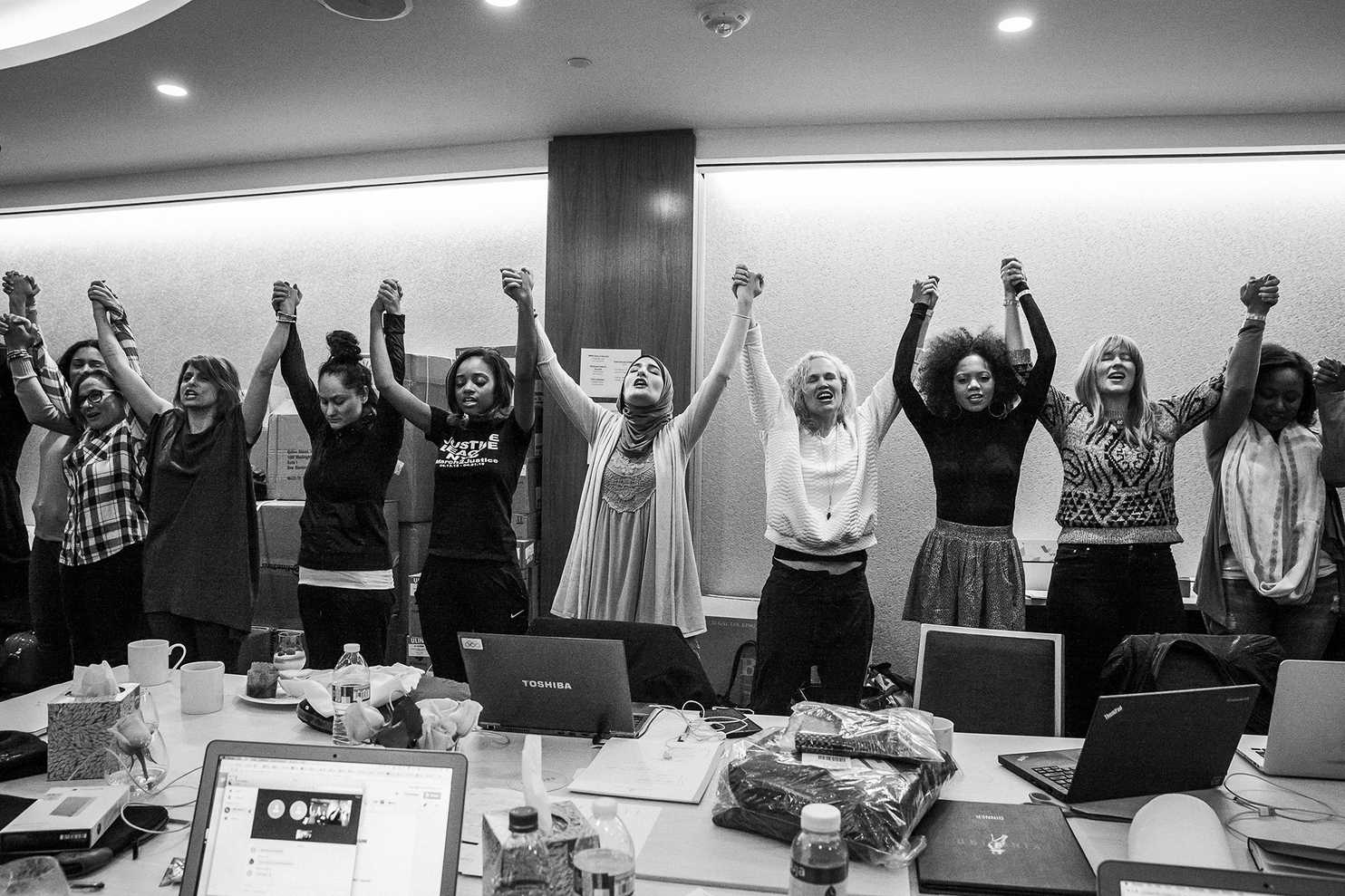
Australian Kisha Bari's exhibition ReSisters: Behind the Scenes of The Women's March, is a project that has seen Kisha cover the Women's March movement since January this year. There are some fantastic images in the show and Kisha has captured wonderful, candid moments. 

"I am honored to present some never before seen imagery of the lead up to the Women's March on Washington from NYC to D.C," says Kisha. "The work presented captures this awesome women-led movement and celebrates the political power of diverse women and their communities to create transformative social change.”


(C) All images Kisha Bari

Panel Discussion: Reclaiming Photography
(C) Danielle Villasana

This should be a great talk (wish I could be there for this alone) featuring founding members of RECLAIM: an alliance of The Everyday Projects, Native Agency, Majority World, Women Photograph, Minority Report [renamed from Visioning Project], and Diversify Photo.

Panelists are:
Laura Beltrán Villamizar (Native Agency)
Shahidul Alam (Majority World)
Daniella Zalcman (Women Photograph)
Brent Lewis (Senior Photo Editor ESPN’s The Undefeated)
Tara Pixley (Scholar/Filmmaker/Photographer)
Austin Merrill (Everyday Projects)

For more details check out the link here.

Random images from exhibitions you should check out if you're lucky enough to be in NYC!

Insider/Outsider - Women Photograph 
(C) Abbie Trayler-Smith 

The Blood and the Rain - Magnum Foundation
(C) Yael Martínez

Carbon's Casualties: How Climate Change is Upending Life Around the World
New York Times (C) Josh Haner

We Have Experienced Calamities
Médecins Sans Frontières (MSF)
(C) Juan Carlos Tomasi

Visit the Photoville website for all the details.


War is Only Half the Story
The Aftermath Project 10th Anniversary
(also exhibiting at Photoville)

(C) Stanley Greene

War is Only Half the Story is a ten-year retrospective of the work of the groundbreaking documentary photography program, The Aftermath Project.

Founded by photographer Sara Terry to help change the way the media covers conflict – and to educate the public about the true cost of war and the real price of peace – The Aftermath Project has run a grant program for the past decade, supporting some of the best documentary photographers in the world working on post-conflict themes. You can check out the project at Photoville.

Juan Arredondo/Finalist, 2016 “Everybody Needs a Good Neighbor”
Angél, 14, and Daniel (right), 16, members of the ELN Che Guevara Front pose for a picture at their camp in Chocó. The Che Guevara front operates on the Pacific coast of Colombia patrolling important corridors to allow the export of cocaine to the Pacific Ocean and into Mexico. February 17, 2014.


Isabel Kiesewetter/Finalist, 2013 “Conversion”
Fusion Festival, Larz Former Rechlin-Larz military airfield
1933 - 1945: Main testing ground of the Third Reich’s Luftwaffe
1945 - 1993: Used by the 19th Fighter Bomber Regiment West of the Group of Soviet Forces in Germany


Stanley Greene/Grant Winner, 2013 “Hidden Scars”
A scarecrow and his guard dog watch over the village of Bamut, which was always a rebel stronghold, and was the last village to fall to Russian forces. The entire village was leveled by the Russian military. Bamut is near the Chechen border with neighboring Ingushetia, which lies to the west of Chechnya. In April 2014, Chechen President Ramzan Kadyrov sent forces on a cross-border raid into Ingushetia. A few years previously, he sent forces on a similar raid into Dagestan, to the east. Kadyrov’s pan-Caucasus ambitions are making his neighbors uneasy. Bamut, Chechnya, 2013. 

The tenth anniversary book, which is co-production with Dewi Lewis Publishing, takes a completely new approach to presenting the work The Aftermath Project has supported. Rather than a chronological order, photographs are curated under five themes, defined by the poetry of Nobel Laureate Poet Wislawa Syzmborska:

“All the cameras have gone to other wars…”
“After every war someone’s got to tidy up…”
“Perhaps all fields are battlefields…”
“This terrifying world is not devoid of charms…”
“Reality demands that we also mention this: Life goes on.”

There is a Kickstarter project to fund the book.

--> --> -->

September 01, 2017

Photojournalism Now: Friday Round Up - 1st September, 2017

Stop press: This week Photojournalism Now was ranked number ten on the Top 50 Photojournalism Blogs in the World by feedspot.com! Thanks to everyone for your support.
  
Special Feature:
29th Edition of Visa Pour L'Image

The International Festival of Photojournalism, Visa Pour L'Image starts in Perpignan, France tomorrow and runs until the 17th September. All exhibitions are free and there is once again an amazing diversity in the works on show. 

Here is a curated selection of what’s on offer. Congratulations to Jean-François Leroy and his team for another amazing festival program. But most importantly, thank you to the extraordinary, dedicated photojournalists who bring us these stories often at great personal cost.

Lu Guang
Development and Pollution


Today China is the world’s second largest economy. Its rapid growth has come with a high environmental toll, China’s seven great rivers poisoned by industrial waste, pastureland destroyed by open-pit mines, and villages turned into death traps. Curated by Jean Loh, this exhibition features images from Guang's 12-year study.


Men at work in the dust. Energy-intensive, polluting industry has been transferred from the east to the central and western regions. Wuhai, Inner Mongolia, 2006. © Lu Guang / Contact Press Images


The main industries in and around the city of Holingol are coal, power and chemicals, causing pollution rendering nearby grassland unfit for grazing. Local authorities have replaced the livestock with sculptures. Inner Mongolia, 2012. © Lu Guang / Contact Press Images


Farmer Li Mingzhu has a cornfield near Tengda lead and zinc smelters. The soil has high concentrations of heavy metals and last year’s crop produced no grain. Jinjiling village, Jiahe County, Hunan Province. March 2010. © Lu Guang / Contact Press Images

Daniel Berehulak
They Are Slaughtering Us Like Animals


Australian photojournalist Daniel Berehulak’s latest Pulitzer Prize winning work saw him spend five weeks in Manila covering the aftermath of President Duterte’s murderous drug crackdown. Working with a local reporter, Berehulak covered 41 crime scenes, and 57 fatalities, his documentation going beyond the crimes to uncover the innocents and the families, revealing the other side to the official story. 


Jimji (6), in anguish screaming “Papa!” before the funeral of Jimboy Bolasa (25). His body, showing signs of torture as well as gunshot wounds, was found under a bridge. The police said he was a drug dealer, but according to his family, Bolasa had surrendered earlier, answering President Duterte's call to follow what was supposed to be a drug-treatment program. Manila, October 10, 2016. © Daniel Berehulak for The New York Times


Relatives overcome with grief seeing the bodies of Frederick Mafe and Arjay Lumbago sprawled in the street. Manila, October 3, 2016. © Daniel Berehulak for The New York Times


Michael Araja (29) was one of a number of people gunned down at a “sari-sari” street kiosk. Neighbors said he had gone to buy cigarettes and a drink for his wife when he was shot dead by two men on a motorcycle, a “riding in tandem killing” which is a common modus operandi. Officers from SOCO (Scene Of the Crime Operations) are gathering evidence. Manila, October 2, 2016. © Daniel Berehulak for The New York Times

Stanley Greene
Homage


Last time I was in Perpignan, in 2013, I had the honour of meeting Stanley Greene. He graciously signed my copy of Trolleyology - “To Alison, be safe in the life!” - this might have been his standard line, but he was generous with his time and interested to hear what this Australian thought of Visa. We talked about his eWaste project, and how he had fallen ill shooting in the toxic environs. In this homage, there is work that spans his career, from the early days of fashion photography through to his profound images of the conflict in Chechnya.


The old souk in the Old City of Aleppo, a UNESCO World Heritage site: once the most charming 4,000 square meters in the Middle East, the most famous postcard in Syria, a vertigo of voices, of tales and colors, overflowing with life. Now all that remains is rubble. April 2, 2013 © Stanley Greene / NOOR


Grozny, Chechnya, January 1995. “Death in Grozny.” Outline of a body in the snow, after a Russian rocket attack: black ash, dark snow, shattered glass, trees now ragged stumps, their branches snapped off by the blasts. The streets of Grozny were a no man's land. © Stanley Greene / NOOR


Downtown Grozny, Chechnya, April 2001. Since the death of her child Zelina often stares into the distance, her eyes seeking something far away, so elusive. She says she is already dead, and if only time would hurry up. © Stanley Greene / NOOR

Meridith Kohut
The Collapse of Venezuela

This distressing, but important body of work from this year’s winner of the Chris Honduras Fund, shows the ravages of the economic collapse of Venezuela on its population. Struggling to survive on meagre rations, Kohut captures a country on the brink of devastation. Her intimate images are raw with emotion, the insights and depth of her storytelling the result of her immersion in the culture; she has lived in Venezuela since 2008.


Omar Mendoza suffers from schizophrenia, and also from severe malnutrition: he weighs only 35 kilos [77 pounds]. The state psychiatric hospital where he is has been crippled by acute shortages of food and medicine. August 25, 2016. © Meridith Kohut for The New York Times


Leidy Cordova (37) with four of her five children: Abran (1), Deliannys (3), Eliannys (6), and Milianny (8). The family had not eaten since lunch the day before, and that was “soup” made by boiling chicken skin and fat. The refrigerator is not working, and contains the only food in the house: half a bag of flour and a bottle of vinegar. June 16, 2016. © Meridith Kohut for The New York Times


Family and friends mourn at a group funeral for four young men who were tortured and killed by members of the Venezuelan armed forces. Capaya November 29, 2016. © Meridith Kohut for The New York Times


Zohra Bensemra
Lives on a Wire

Algerian photojournalist Zohra Bensemra focuses her gaze on those whose lives have been shattered by war. She says her objective is simple: to show that all human beings, no matter their religion or nationality, are the same. 


After fleeing a village controlled by Islamic State fighters, a boy and his family are in a bus that will take them to the refugee camp in Hammam al-Alil, south of Mosul, Iraq. February 22, 2017. © Zohra Bensemra / Reuters


The mother at the funeral of Mohammed Ali Khan (15) who was killed in the massacre when the Army Public School he attended was attacked by Taliban gunmen who took hundreds of students and teachers hostage. Peshawar, Pakistan, December 16, 2014. © Zohra Bensemra / Reuters


Voting in the country’s first democratic elections for almost a quarter of a century. Al-Fashir, Northern Darfur, Sudan, April 11, 2010. © Zohra Bensemra / Reuters


Ed Kashi
CKDu - In the Hot Zone

American photojournalist Ed Kashi reveals a deadly epidemic sweeping the Middle East, Asia, South Asia and Central America. CKDu, Chronic Kidney Disease of unknown origin, affects mainly farm workers and their families, the poor and the young. Travelling to Nicaragua, El Salvador, India and Sri Lanka, Kashi has documented the ravages of this fatal disease and its multi-generational impact. 

Jorge Martin Bonilla (29), the youngest of six brothers, three of whom are also suffering from CKDu [Chronic Kidney Disease of unknown origin], worked on sugarcane plantations for five years before contracting CKDu in 2004. He died this morning. Chichigalpa, Nicaragua, April 30, 2014. © Ed Kashi / VII


At Narayana Medical College, Nellore, Andhra Pradesh, India. January, 2016. © Ed Kashi / VII

Mass screening is conducted by a local CKDu organization, with support from the government. Here, in this CKDu-affected town, 342 secondary school students are lining up for blood tests. Rajanganaya, North Central Province, Sri Lanka, June, 2016. © Ed Kashi / VII

Visit the website for more information

December 09, 2016

Friday Round Up - 9th December, 2016

This week on Photojournalism Now: Friday Round Up Stephen Dupont's Generation AK reviewed, Out of the Phone launches a new publishing platform for mobile photographers, plus links to Daniel Berehulak's brilliant photo essay and article on the Philippines savage anti drug campaign and the winners of Lensculture's Emerging Talent 2016.

Book review: Stephen Dupont 
Generation AK The Afghanistan Wars 1993-2012


I would that my photographs might be, not the coverage of a news event, but an indictment of war - the brutal corrupting viciousness of its doing to the minds and bodies of men; and, that my photographs might be a powerful emotional catalyst to the reasoning which would help this vile and criminal stupidity from beginning again. W. Eugene Smith.

This quote from W. Eugene Smith appears at the beginning of Stephen Dupont's opus on Afghanistan, which is a heavy tome in every sense of the word. But don't let that deter you as this is a story that needs to be told, needs to be looked at. What we know of Afghanistan is largely influenced by what we see on the nightly news and in newspapers and magazines. But these snapshots can't give an insight into the country and its people the way Dupont's 20 year study does.


Generation AK is sectioned into chapters each of which begin with diary entries from Dupont. Words and pictures need each other and Dupont's reminiscing helps to draw the reader into the photographer's world, albeit if only in our imagination because if you haven't done it, you cannot really imagine what it must be like to submerge yourself in a war zone. To do so voluntarily is another story altogether. But without photographers like Dupont these stories would never be told.

Dupont has an engaging storytelling manner, and his words sweep you along in the drama. As you move through the first chapter, The Civil War 1993-2001, the sounds of rockets exploding and bullets screaming overhead become an inner soundtrack to the anxiety riddled faces of the people who came under Dupont's gaze.

In the chapter on the guerrilla leader Ahmed Shah Massoud, Dupont tells how when he was travelling to meet Massoud he shared a helicopter ride with a dead Afghan General, the aircraft filled with the smell of "rotting flesh, formaldehyde and diesel fumes." My nose twitches with the suggestion, but the thought is quickly replaced by the force of the images, which capture Massoud with his followers as well as in quiet, reflective moments that make you wonder what this man who was idolised by his followers was really like.


Dupont's series Stoned in Kabul, where he followed two heroin addicted brothers Reza and Hussein, is also featured in Generation AK. I've seen this work in exhibition and it's truly startling, raw and unnerving, reflecting the savagery and desperate nature of life on the streets of Kabul.


The series Axe Me Biggie (explained as "a crude Anglo phonetic rendering of the Dari for Mister, take my picture") also features. Dupont shot these pictures in a three hour window on the streets of Kabul. The series comprises 18 portraits of Afghans photographed in front of a piece of black fabric rigged up to create a makeshift studio. These portraits say 'take my picture, let people see me, let people know that I am not defeated, let me look you in the eye and tell you my story'.


I first interviewed Dupont in 2008 not long after he had returned from Afghanistan where he'd narrowly missed being blown to pieces in a suicide bombing. He'd been travelling with a poppy eradication unit. In the book Dupont gives an account of that day and how he was operating on auto-pilot as he shot and filmed the scene, in which fellow Australian journalist Paul Raffaele was seriously injured. The pictures leave the viewer with little doubt that Dupont was lucky to have escaped this tour with his life.

Generation AK is a book that requires time to look at otherwise it become too overwhelming and the story gets lost in the horror of war. Dupont is a master storyteller. He knows how to build the pace, to combine images that convey a narrative that is complex yet accessible.

It always feels odd to talk about aesthetics when the subject matter is so grim, but this is a beautiful book and the reproduction of images in both black & white and colour is superb, which is what you would expect from Steidl. The book features a foreword written by Jacques Menasche.

When I look at Dupont's work the overriding emotion I feel is respect. Respect for this photographer who is driven to tell these amazing stories often at great personal risk and cost. And respect for the human spirit and the will to survive even in the face of untold horrors.

This is important work. Don't look away.

To buy the book visit Steidl 
To see more of Stephen Dupont's work visit his website

On-Demand Books:
Out of the Phone Publishing


While we're talking about books, for those who can't get a deal with the likes of Steidl, or who just want to get their pictures off their phone and onto paper, Paris publishing house Out of the Phone (OOTP) has come up with a print-on-demand book idea that allows photographers to produce inexpensive books that are quirky and personal.


The first OOTP print-on-demand photo book is a travel notebook with a specific format and pagination that allows you to present up to 50 pictures. Produced in France, the travel notebook has an artisanal look and feel. Founder of OOTP Pierre Le Govic is hoping to raise funds on Indiegogo to build a website for what he is calling the 'world's first print-on-demand photo book platform for mobile photographers'. If you’re interested, take a look here.  

Weekend Reading: 

New York Times


More amazing work by Pulitzer Prize winning photojournalist Australian Daniel Berehulak on the savage anti-drug campaign being waged in the Philippines where Berehulak documented 57 homicide victims over 35 days. Berehulak photographed and wrote the story for the New York Times. Here's an excerpt: 

“The rain-soaked alley in the Pasay district of Manila was my 17th crime scene, on my 11th day in the Philippines capital. I had come to document the bloody and chaotic campaign against drugs that President Rodrigo Duterte began when he took office on June 30: since then, about 2000 people had been slain at the hands of the police alone….”

Awards:
Lensculture 2016 Emerging Talent


Check out the top 50 in this year's Lensculture Emerging Talent competition, including Polish photographer Wiktoria Wojciechowska who I met at Paris Photo last year. She was one of eight in the Jurors's pick for her body of work, Sparks, which she describes as 'a multifaceted portrait of a contemporary war', in this case the conflict in Ukraine. 

The gold leaf depicts those who didn't make it home