September 22, 2017

Photojournalism Now: Friday Round Up - 22nd September, 2017

This week on Photojournalism Now: Friday Round Up - the Indian Photography Festival opens in Hyderabad and locally Press Dynasty opens at Magnet Galleries Melbourne.

Festival: 
Indian Photography Festival - Hyderabad


(C) Kate Geraghty

The third edition of the Indian Photography Festival (IPF) opened yesterday. I had the pleasure of playing a small role in the curation of IPF by participating in the selection of the open call entries. I enjoyed the opportunity to view work by many photographers I didn't know, surely one of the greatest attractions of festivals like this.

This year the program boasts more than 520 photographers from 40 countries showcasing a diverse range of work. It's great to see Australian photojournalist Kate Geraghty's work on the drug war in the Philippines (above) as one of the major exhibitions. Other photographers participating in various capacities (workshops, artist talks and presentations) include Natan Dvir, Andrea Bruce, Reza Deghati, Stuart Franklin, Sudharak Olwe, Q Sakamaki, Cecilia Paredes, Prashant Godbole, Manoj Jadhav and Gurinder Osan.

Plus there is a host of lesser known photographers from which selected works are featured here:

Helena Schätzle - Dharavi, Mumbai


Telaj Mewar
Indian Brick Workers


Camillo Pasquarelli - The Endless Winter of Kashmir
Student award of excellence, 2017 Alexia Foundation


Sabine Hartert - Absences


The IPF runs until 8 October. To find out more visit the festival website

Exhibition: Melbourne
Bruce & Cliff Postle - Press Dynasty


I don't know how many father and son press photographers there have been, but in Australia the Postle name has been synonymous with newspapers since the 1920s when Cliff Postle was shooting for the Brisbane Courier-Mail. His son Bruce followed in his father's footsteps, first with the Courier-Mail before making the move to Melbourne and carving a name for himself at The Age. 

This retrospective at Melbourne's Magnet Galleries brings together a selection of images never exhibited together, presenting a fascinating walk down memory lane for many, as well as insights into our recent history.

Until 14 October
Magnet Galleries Melbourne
Level 2
640 Bourke Street
Melbourne

September 15, 2017

Photojournalism Now: Friday Round Up - 15th September, 2017

This week on Photojournalism Now: Friday Round Up - a special feature on Photoville New York, plus The Aftermath Project 10th Anniversary.

Special Feature:
Photoville 2017

(C) Kisha Bari

Since its inception in 2012 Photoville has become the largest annual photographic event in New York City, with more than 90,000 attending last year. The festival features exhibitions in and on more than 55 shipping containers in Brooklyn Bridge Plaza, as well as night projections, workshops, debates, and a mini-trade show with vendors, publishers and gear demonstrators. Free of charge and open to the public, Photoville is unlike any other photo festival in the world.

This year Photoville runs over two (unofficial) long weekends 13-17 and 21-24 September.

Newest Americans, a storytelling project about immigration and American identity, kicked off Photoville this week with a live projection in the famed Photoville Beer Garden, in collaboration with Talking Eyes, VII and Rutgers University-Newark. Newest Americans chronicles the immigrant experience using documentary film, photography, fiction and nonfiction essays, podcasting and interactive storytelling, to present "fresh narratives on the emerging majority-minority population and the nation it is transforming."  

(C) Ed Kashi 

(C) Ron Haviv

(C) Julie Winokur

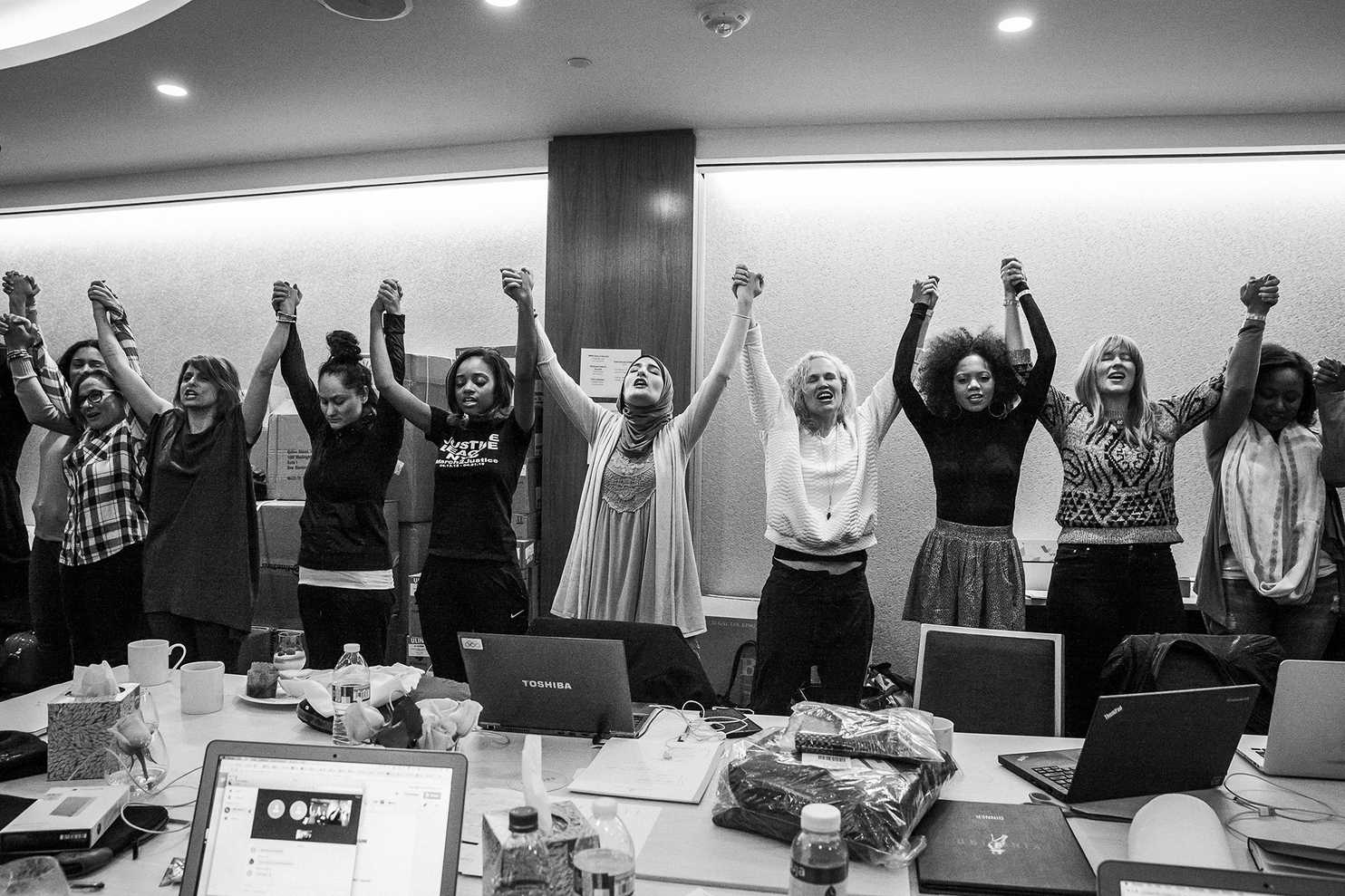
Kisha Bari - ReSisters: Behind the Scenes of The Women's March

Australian Kisha Bari's exhibition ReSisters: Behind the Scenes of The Women's March, is a project that has seen Kisha cover the Women's March movement since January this year. There are some fantastic images in the show and Kisha has captured wonderful, candid moments. 

"I am honored to present some never before seen imagery of the lead up to the Women's March on Washington from NYC to D.C," says Kisha. "The work presented captures this awesome women-led movement and celebrates the political power of diverse women and their communities to create transformative social change.”


(C) All images Kisha Bari

Panel Discussion: Reclaiming Photography
(C) Danielle Villasana

This should be a great talk (wish I could be there for this alone) featuring founding members of RECLAIM: an alliance of The Everyday Projects, Native Agency, Majority World, Women Photograph, Minority Report [renamed from Visioning Project], and Diversify Photo.

Panelists are:
Laura Beltrán Villamizar (Native Agency)
Shahidul Alam (Majority World)
Daniella Zalcman (Women Photograph)
Brent Lewis (Senior Photo Editor ESPN’s The Undefeated)
Tara Pixley (Scholar/Filmmaker/Photographer)
Austin Merrill (Everyday Projects)

For more details check out the link here.

Random images from exhibitions you should check out if you're lucky enough to be in NYC!

Insider/Outsider - Women Photograph 
(C) Abbie Trayler-Smith 

The Blood and the Rain - Magnum Foundation
(C) Yael Martínez

Carbon's Casualties: How Climate Change is Upending Life Around the World
New York Times (C) Josh Haner

We Have Experienced Calamities
Médecins Sans Frontières (MSF)
(C) Juan Carlos Tomasi

Visit the Photoville website for all the details.


War is Only Half the Story
The Aftermath Project 10th Anniversary
(also exhibiting at Photoville)

(C) Stanley Greene

War is Only Half the Story is a ten-year retrospective of the work of the groundbreaking documentary photography program, The Aftermath Project.

Founded by photographer Sara Terry to help change the way the media covers conflict – and to educate the public about the true cost of war and the real price of peace – The Aftermath Project has run a grant program for the past decade, supporting some of the best documentary photographers in the world working on post-conflict themes. You can check out the project at Photoville.

Juan Arredondo/Finalist, 2016 “Everybody Needs a Good Neighbor”
Angél, 14, and Daniel (right), 16, members of the ELN Che Guevara Front pose for a picture at their camp in Chocó. The Che Guevara front operates on the Pacific coast of Colombia patrolling important corridors to allow the export of cocaine to the Pacific Ocean and into Mexico. February 17, 2014.


Isabel Kiesewetter/Finalist, 2013 “Conversion”
Fusion Festival, Larz Former Rechlin-Larz military airfield
1933 - 1945: Main testing ground of the Third Reich’s Luftwaffe
1945 - 1993: Used by the 19th Fighter Bomber Regiment West of the Group of Soviet Forces in Germany


Stanley Greene/Grant Winner, 2013 “Hidden Scars”
A scarecrow and his guard dog watch over the village of Bamut, which was always a rebel stronghold, and was the last village to fall to Russian forces. The entire village was leveled by the Russian military. Bamut is near the Chechen border with neighboring Ingushetia, which lies to the west of Chechnya. In April 2014, Chechen President Ramzan Kadyrov sent forces on a cross-border raid into Ingushetia. A few years previously, he sent forces on a similar raid into Dagestan, to the east. Kadyrov’s pan-Caucasus ambitions are making his neighbors uneasy. Bamut, Chechnya, 2013. 

The tenth anniversary book, which is co-production with Dewi Lewis Publishing, takes a completely new approach to presenting the work The Aftermath Project has supported. Rather than a chronological order, photographs are curated under five themes, defined by the poetry of Nobel Laureate Poet Wislawa Syzmborska:

“All the cameras have gone to other wars…”
“After every war someone’s got to tidy up…”
“Perhaps all fields are battlefields…”
“This terrifying world is not devoid of charms…”
“Reality demands that we also mention this: Life goes on.”

There is a Kickstarter project to fund the book.

--> --> -->

September 08, 2017

Photojournalism Now: Friday Round Up - 8th September, 2017

This week on Photojournalism Now: Friday Round Up - Getty Images announces grant winners at Visa Pour L'Image, Vlad Sokhin wins for Warm Waters and Head On Photo Festival 2018 calls for submissions.

Awards:
Getty Grants for Editorial Photography 2017


Five photojournalists have been awarded a grant of $10,000 each in this year's round of Getty Images Grants for Editorial Photography which will enable them to continue working on, what are, extraordinary and important stories.

Hugh Pinney, Vice President of News, Getty Images said the winners were photojournalists “working at the cutting edge...ensuring that often ignored global issues are brought to the forefront of public consciousness. The projects selected explore a range of complex and thought-provoking subjects and we are thrilled that, through the Getty Images Editorial Photography Grant, we are able to support such talent as they continue to shed light on some of the most moving and significant moments of our time.”

And the winners are:

Alejandro Cegarra for Living with Hugo Chavez’s Legacy

'In the latter years of Hugo Chavez’s presidency, Venezuela enjoyed an oil-fueled economic boom that made his vision of a more equitable, wealthier and safer society seem almost attainable. But by the time of his death, in 2013, he left his successor an economy in shambles, tenuous political support, and rising violence. Four years on, the country has been plunged back into a state of poverty and conflict, with citizens struggling to afford food and the youth clashing with the security forces on a regular basis. This project seeks to give a voice to the frustrated and disappointed people of Venezuela who feel consistently ignored by those above them." Alejandro Cegarra.

(C) Alejandro Cegarra

Paula Bronstein for The Cost of War 

"Following the US-backed military operation against ISIS in the Iraqi city of Mosul, the threat to civilians in the region remains high. The use of mines in the city poses a serious problem for civilians, who are the most common victims of such devices. More worrying still is the revelation that, according to the Mines Advisory group, these mines contain 60 times more explosives than a standard anti-personnel mine, drastically increasing the likelihood of death or severe and permanent injury. This project aims to document the silent victims of a conflict that has claimed thousands of lives and left many more maimed." Paula Bronstein.

(C) Paula Bronstein

Antonio Faccilongo for Habibi 

"The Gaza Strip and the West Bank are typically portrayed as places ravaged by conflict, however for the citizens of these regions they are also home, a place where they must build a life amidst the turmoil. This project focuses on the phenomena of ‘sperm smuggling’ by Palestinian women, a practice which allows them to conceive children with their husbands who are serving long term sentences in Israeli prisons. Family remains the most important social structure for many Palestinians and for many of these women this is their only hope for a family." Antonio Faccilongo.

(C) Antonio Faccilongo

Barbara Peacock for American Bedroom 

"The transformation of the pedestrian into objects of artistic merit has long been one of the aims of photography and it is this tradition that the project seeks to continue. In focusing on the commonplace this project hopes to unveil the idiosyncrasies latent in everyday life. The expansive nature of the project invites us to introspect on the complexity of humankind in the west, particularly in America." Barbara Peacock.


(C) Barbara Peacock

Alessandro Penso for The Deal

"The refugee crisis in Europe has dominated the media over the last few years, with xenophobia and closed mindedness often leading the debate. It is therefore vital that we ask, what are the consequences of such attitudes? This project explores the way in which EU regulation has failed to adequately welcome refugees by depicting the exploitation and long-term displacement faced by many of these already extremely vulnerable people." Alessandro Penso


(C) Alessandro Penso

Since its conception in 2005, Getty Images Editorial Grants program has provided grants in excess of US$1.4 million. Congratulations to the winners!


Award:
Vlad Sokhin wins Visa d'or France Award for the Best Digital News Story


Big shout out and congratulations to Vlad Sokhin for winning this award for his work, Warm Waters. I've interviewed Vlad a few times over the years and he's doing some brilliant work on important topics and drawing global attention.

This year's jury members were: Dimitri Beck / Polka, Samuel Bollendorff, photographer and president of the jury, Agnès Chauveau / INA, Pascal Delannoy / franceinfo, Olivier Laurent / Washington Post, Benoit Leprince / Paris Match, Marie Sumalla / Le Monde and Marie Valla, FRANCE 24. The Award is sponsored by rance Médias Monde, France Télévisions, Radio France and INA.

Some other photos from Vlad's Warm Waters series:


Call for Submissions:
Head On Photo Festival 2018

Australia's largest photography festival, Head On, held annually in Sydney, is calling for submissions for exhibitions. Check out the link here

September 01, 2017

Photojournalism Now: Friday Round Up - 1st September, 2017

Stop press: This week Photojournalism Now was ranked number ten on the Top 50 Photojournalism Blogs in the World by feedspot.com! Thanks to everyone for your support.
  
Special Feature:
29th Edition of Visa Pour L'Image

The International Festival of Photojournalism, Visa Pour L'Image starts in Perpignan, France tomorrow and runs until the 17th September. All exhibitions are free and there is once again an amazing diversity in the works on show. 

Here is a curated selection of what’s on offer. Congratulations to Jean-François Leroy and his team for another amazing festival program. But most importantly, thank you to the extraordinary, dedicated photojournalists who bring us these stories often at great personal cost.

Lu Guang
Development and Pollution


Today China is the world’s second largest economy. Its rapid growth has come with a high environmental toll, China’s seven great rivers poisoned by industrial waste, pastureland destroyed by open-pit mines, and villages turned into death traps. Curated by Jean Loh, this exhibition features images from Guang's 12-year study.


Men at work in the dust. Energy-intensive, polluting industry has been transferred from the east to the central and western regions. Wuhai, Inner Mongolia, 2006. © Lu Guang / Contact Press Images


The main industries in and around the city of Holingol are coal, power and chemicals, causing pollution rendering nearby grassland unfit for grazing. Local authorities have replaced the livestock with sculptures. Inner Mongolia, 2012. © Lu Guang / Contact Press Images


Farmer Li Mingzhu has a cornfield near Tengda lead and zinc smelters. The soil has high concentrations of heavy metals and last year’s crop produced no grain. Jinjiling village, Jiahe County, Hunan Province. March 2010. © Lu Guang / Contact Press Images

Daniel Berehulak
They Are Slaughtering Us Like Animals


Australian photojournalist Daniel Berehulak’s latest Pulitzer Prize winning work saw him spend five weeks in Manila covering the aftermath of President Duterte’s murderous drug crackdown. Working with a local reporter, Berehulak covered 41 crime scenes, and 57 fatalities, his documentation going beyond the crimes to uncover the innocents and the families, revealing the other side to the official story. 


Jimji (6), in anguish screaming “Papa!” before the funeral of Jimboy Bolasa (25). His body, showing signs of torture as well as gunshot wounds, was found under a bridge. The police said he was a drug dealer, but according to his family, Bolasa had surrendered earlier, answering President Duterte's call to follow what was supposed to be a drug-treatment program. Manila, October 10, 2016. © Daniel Berehulak for The New York Times


Relatives overcome with grief seeing the bodies of Frederick Mafe and Arjay Lumbago sprawled in the street. Manila, October 3, 2016. © Daniel Berehulak for The New York Times


Michael Araja (29) was one of a number of people gunned down at a “sari-sari” street kiosk. Neighbors said he had gone to buy cigarettes and a drink for his wife when he was shot dead by two men on a motorcycle, a “riding in tandem killing” which is a common modus operandi. Officers from SOCO (Scene Of the Crime Operations) are gathering evidence. Manila, October 2, 2016. © Daniel Berehulak for The New York Times

Stanley Greene
Homage


Last time I was in Perpignan, in 2013, I had the honour of meeting Stanley Greene. He graciously signed my copy of Trolleyology - “To Alison, be safe in the life!” - this might have been his standard line, but he was generous with his time and interested to hear what this Australian thought of Visa. We talked about his eWaste project, and how he had fallen ill shooting in the toxic environs. In this homage, there is work that spans his career, from the early days of fashion photography through to his profound images of the conflict in Chechnya.


The old souk in the Old City of Aleppo, a UNESCO World Heritage site: once the most charming 4,000 square meters in the Middle East, the most famous postcard in Syria, a vertigo of voices, of tales and colors, overflowing with life. Now all that remains is rubble. April 2, 2013 © Stanley Greene / NOOR


Grozny, Chechnya, January 1995. “Death in Grozny.” Outline of a body in the snow, after a Russian rocket attack: black ash, dark snow, shattered glass, trees now ragged stumps, their branches snapped off by the blasts. The streets of Grozny were a no man's land. © Stanley Greene / NOOR


Downtown Grozny, Chechnya, April 2001. Since the death of her child Zelina often stares into the distance, her eyes seeking something far away, so elusive. She says she is already dead, and if only time would hurry up. © Stanley Greene / NOOR

Meridith Kohut
The Collapse of Venezuela

This distressing, but important body of work from this year’s winner of the Chris Honduras Fund, shows the ravages of the economic collapse of Venezuela on its population. Struggling to survive on meagre rations, Kohut captures a country on the brink of devastation. Her intimate images are raw with emotion, the insights and depth of her storytelling the result of her immersion in the culture; she has lived in Venezuela since 2008.


Omar Mendoza suffers from schizophrenia, and also from severe malnutrition: he weighs only 35 kilos [77 pounds]. The state psychiatric hospital where he is has been crippled by acute shortages of food and medicine. August 25, 2016. © Meridith Kohut for The New York Times


Leidy Cordova (37) with four of her five children: Abran (1), Deliannys (3), Eliannys (6), and Milianny (8). The family had not eaten since lunch the day before, and that was “soup” made by boiling chicken skin and fat. The refrigerator is not working, and contains the only food in the house: half a bag of flour and a bottle of vinegar. June 16, 2016. © Meridith Kohut for The New York Times


Family and friends mourn at a group funeral for four young men who were tortured and killed by members of the Venezuelan armed forces. Capaya November 29, 2016. © Meridith Kohut for The New York Times


Zohra Bensemra
Lives on a Wire

Algerian photojournalist Zohra Bensemra focuses her gaze on those whose lives have been shattered by war. She says her objective is simple: to show that all human beings, no matter their religion or nationality, are the same. 


After fleeing a village controlled by Islamic State fighters, a boy and his family are in a bus that will take them to the refugee camp in Hammam al-Alil, south of Mosul, Iraq. February 22, 2017. © Zohra Bensemra / Reuters


The mother at the funeral of Mohammed Ali Khan (15) who was killed in the massacre when the Army Public School he attended was attacked by Taliban gunmen who took hundreds of students and teachers hostage. Peshawar, Pakistan, December 16, 2014. © Zohra Bensemra / Reuters


Voting in the country’s first democratic elections for almost a quarter of a century. Al-Fashir, Northern Darfur, Sudan, April 11, 2010. © Zohra Bensemra / Reuters


Ed Kashi
CKDu - In the Hot Zone

American photojournalist Ed Kashi reveals a deadly epidemic sweeping the Middle East, Asia, South Asia and Central America. CKDu, Chronic Kidney Disease of unknown origin, affects mainly farm workers and their families, the poor and the young. Travelling to Nicaragua, El Salvador, India and Sri Lanka, Kashi has documented the ravages of this fatal disease and its multi-generational impact. 

Jorge Martin Bonilla (29), the youngest of six brothers, three of whom are also suffering from CKDu [Chronic Kidney Disease of unknown origin], worked on sugarcane plantations for five years before contracting CKDu in 2004. He died this morning. Chichigalpa, Nicaragua, April 30, 2014. © Ed Kashi / VII


At Narayana Medical College, Nellore, Andhra Pradesh, India. January, 2016. © Ed Kashi / VII

Mass screening is conducted by a local CKDu organization, with support from the government. Here, in this CKDu-affected town, 342 secondary school students are lining up for blood tests. Rajanganaya, North Central Province, Sri Lanka, June, 2016. © Ed Kashi / VII

Visit the website for more information