Showing posts with label photoville. Show all posts

September 15, 2017

Photojournalism Now: Friday Round Up - 15th September, 2017

This week on Photojournalism Now: Friday Round Up - a special feature on Photoville New York, plus The Aftermath Project 10th Anniversary.

Special Feature:
Photoville 2017

(C) Kisha Bari

Since its inception in 2012 Photoville has become the largest annual photographic event in New York City, with more than 90,000 attending last year. The festival features exhibitions in and on more than 55 shipping containers in Brooklyn Bridge Plaza, as well as night projections, workshops, debates, and a mini-trade show with vendors, publishers and gear demonstrators. Free of charge and open to the public, Photoville is unlike any other photo festival in the world.

This year Photoville runs over two (unofficial) long weekends 13-17 and 21-24 September.

Newest Americans, a storytelling project about immigration and American identity, kicked off Photoville this week with a live projection in the famed Photoville Beer Garden, in collaboration with Talking Eyes, VII and Rutgers University-Newark. Newest Americans chronicles the immigrant experience using documentary film, photography, fiction and nonfiction essays, podcasting and interactive storytelling, to present "fresh narratives on the emerging majority-minority population and the nation it is transforming."  

(C) Ed Kashi 

(C) Ron Haviv

(C) Julie Winokur

Kisha Bari - ReSisters: Behind the Scenes of The Women's March
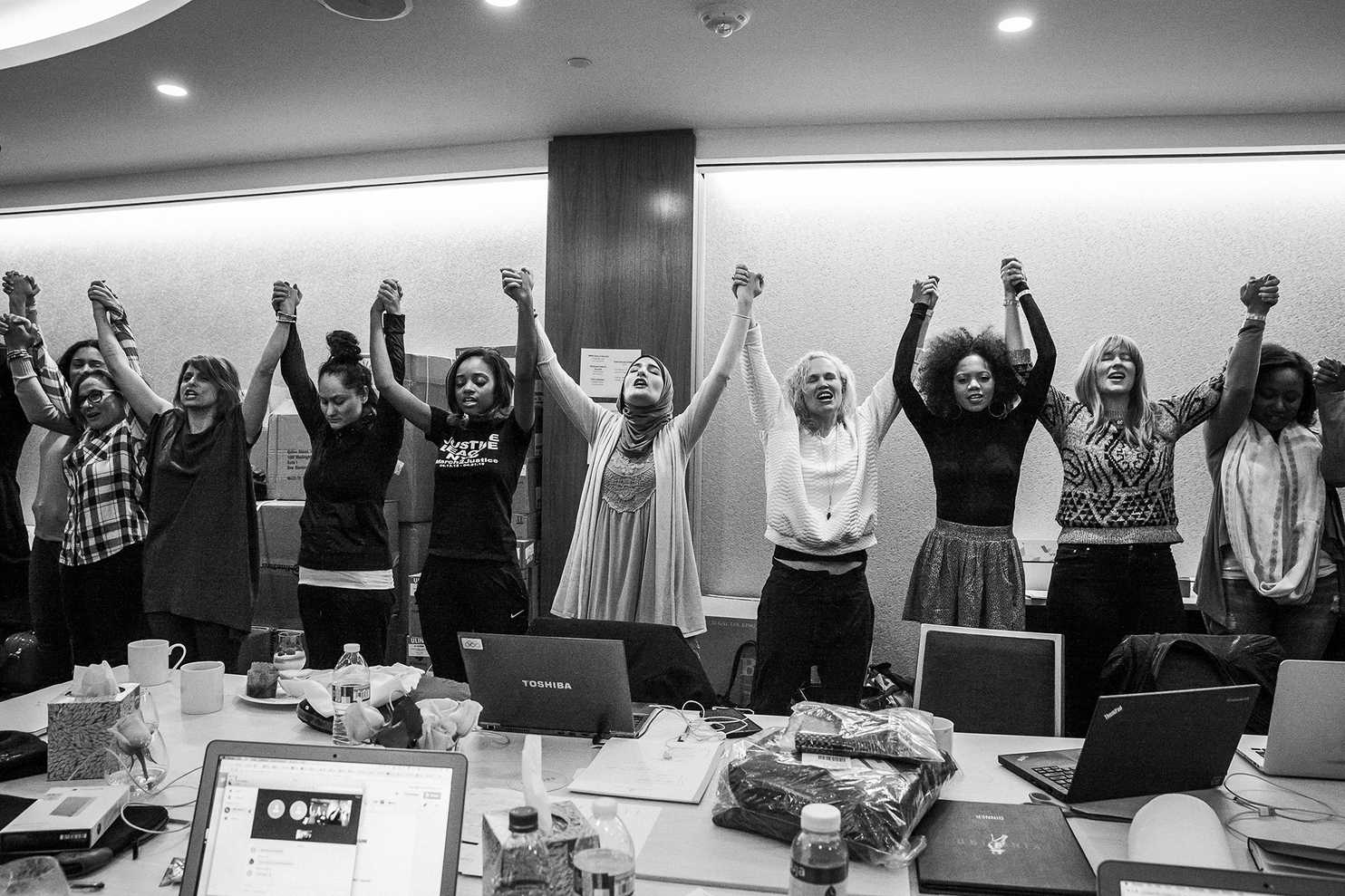
Australian Kisha Bari's exhibition ReSisters: Behind the Scenes of The Women's March, is a project that has seen Kisha cover the Women's March movement since January this year. There are some fantastic images in the show and Kisha has captured wonderful, candid moments. 

"I am honored to present some never before seen imagery of the lead up to the Women's March on Washington from NYC to D.C," says Kisha. "The work presented captures this awesome women-led movement and celebrates the political power of diverse women and their communities to create transformative social change.”


(C) All images Kisha Bari

Panel Discussion: Reclaiming Photography
(C) Danielle Villasana

This should be a great talk (wish I could be there for this alone) featuring founding members of RECLAIM: an alliance of The Everyday Projects, Native Agency, Majority World, Women Photograph, Minority Report [renamed from Visioning Project], and Diversify Photo.

Panelists are:
Laura Beltrán Villamizar (Native Agency)
Shahidul Alam (Majority World)
Daniella Zalcman (Women Photograph)
Brent Lewis (Senior Photo Editor ESPN’s The Undefeated)
Tara Pixley (Scholar/Filmmaker/Photographer)
Austin Merrill (Everyday Projects)

For more details check out the link here.

Random images from exhibitions you should check out if you're lucky enough to be in NYC!

Insider/Outsider - Women Photograph 
(C) Abbie Trayler-Smith 

The Blood and the Rain - Magnum Foundation
(C) Yael Martínez

Carbon's Casualties: How Climate Change is Upending Life Around the World
New York Times (C) Josh Haner

We Have Experienced Calamities
Médecins Sans Frontières (MSF)
(C) Juan Carlos Tomasi

Visit the Photoville website for all the details.


War is Only Half the Story
The Aftermath Project 10th Anniversary
(also exhibiting at Photoville)

(C) Stanley Greene

War is Only Half the Story is a ten-year retrospective of the work of the groundbreaking documentary photography program, The Aftermath Project.

Founded by photographer Sara Terry to help change the way the media covers conflict – and to educate the public about the true cost of war and the real price of peace – The Aftermath Project has run a grant program for the past decade, supporting some of the best documentary photographers in the world working on post-conflict themes. You can check out the project at Photoville.

Juan Arredondo/Finalist, 2016 “Everybody Needs a Good Neighbor”
Angél, 14, and Daniel (right), 16, members of the ELN Che Guevara Front pose for a picture at their camp in Chocó. The Che Guevara front operates on the Pacific coast of Colombia patrolling important corridors to allow the export of cocaine to the Pacific Ocean and into Mexico. February 17, 2014.


Isabel Kiesewetter/Finalist, 2013 “Conversion”
Fusion Festival, Larz Former Rechlin-Larz military airfield
1933 - 1945: Main testing ground of the Third Reich’s Luftwaffe
1945 - 1993: Used by the 19th Fighter Bomber Regiment West of the Group of Soviet Forces in Germany


Stanley Greene/Grant Winner, 2013 “Hidden Scars”
A scarecrow and his guard dog watch over the village of Bamut, which was always a rebel stronghold, and was the last village to fall to Russian forces. The entire village was leveled by the Russian military. Bamut is near the Chechen border with neighboring Ingushetia, which lies to the west of Chechnya. In April 2014, Chechen President Ramzan Kadyrov sent forces on a cross-border raid into Ingushetia. A few years previously, he sent forces on a similar raid into Dagestan, to the east. Kadyrov’s pan-Caucasus ambitions are making his neighbors uneasy. Bamut, Chechnya, 2013. 

The tenth anniversary book, which is co-production with Dewi Lewis Publishing, takes a completely new approach to presenting the work The Aftermath Project has supported. Rather than a chronological order, photographs are curated under five themes, defined by the poetry of Nobel Laureate Poet Wislawa Syzmborska:

“All the cameras have gone to other wars…”
“After every war someone’s got to tidy up…”
“Perhaps all fields are battlefields…”
“This terrifying world is not devoid of charms…”
“Reality demands that we also mention this: Life goes on.”

There is a Kickstarter project to fund the book.

--> --> -->

September 23, 2016

Friday Round Up - 23 September, 2016

This week on Photojournalism Now: Friday Round Up we're in Paris, New York and Amsterdam with French photographer Viviane Dalles, Photoville under the Brooklyn Bridge and at Foam for the amazing exhibition 100 years of Albanian photography.

Exhibition: Paris
Viviane Dalles - Teenage Mothers


French photojournalist Viviane Dalles new exhibition on teenage mothers is currently showing in Paris. Dalles, the 2014 winner of the Canon Female Photojournalist Award, said, “In France, five thousand juvenile mothers (aged 14 to 18) who may not have wanted to be pregnant, chose to keep their babies – a difficult and unusual choice in modern western societies. They dropped out of school to build a new life, caught between the turmoil of their teenage years and the happiness of motherhood.” This photo essay captures part of their journey.

Until 22 October
Fait & Cause
58, rue Quincampoix
75004 Paris

Festival: New York
Photoville


The fifth edition of Photoville is happening right now on the Brooklyn Waterfront. This year the festival is on under the iconic Brooklyn Bridge in the arts precinct of Dumbo. Once again there are exhibitions in containers as well as outdoors, plus there is a projections and workshop programme. Many exhibitions are multi-platform involving photography, moving image and audio as well as other art forms including sculpture.

Here’s a peek at what’s on offer in the container exhibition programme:

Haul
Emily Schiffer 


In this project which uses photography and sculpture American artist Emily Schiffer reimagines the concept of a family album “to explore how unspoken histories and traumas are passed between generations”. The exhibition is in three parts: The Album and the sculptural works, Impressions from 2016 and Gift to My Daughter.

LiveZEKE 
(C)Ara Oshagan
Through video conferencing LiveZEKE brings the subjects of a documentary into a live conversation with audiences. LiveZEKE is based on a feature article from the spring 2016 edition of ZEKE magazine - “The Forgotten Caucasus” - which showcases documentary photography from the countries and regions of the South Caucasus — Armenia, Azerbaijan, Georgia and Nagorno-Karabakh — by photographers Ara Oshagan, Daro Sulakauri and Jan Zychlinski.

Political Theatre
Mark Peterson


New York photographer Mark Peterson has spent the past two years photographing presidential candidates. He says, "I want to pull back the curtain and show these politicians as they really are. Even though they are in plain sight, they can hide behind words and carefully arranged imagery to project their vision of America. I am using my camera to cut through the staging of these moments and reveal the cold, naked ambition for power”.

Signs of Your Identity
Daniella Zalcman 

Winner of this year’s FotoEvidence Book Award, Daniella Zalcman's Signs of Your Identity explores the impact of Canada’s residential schools on its indigenous people. “Generations of Canada’s First Nations forgot who they were. Languages died out, sacred ceremonies were criminalized and suppressed. These double exposure portraits explore the trauma of some of the 80,000 living survivors who remain. Through extensive accompanying interviews, they address the impact of intergenerational trauma and lateral violence, documenting the slow path toward healing. The last residential school closed in 1996. The Canadian government issued its first formal apology in 2008”.

A Few Acres of Snow 

(C) Tim Smith
This group show on the cultural diversity of Canada features work by Rafal Gerszak, Christopher Katsarov Luna, Yoanis Menge, Jalani Morgan, Renaud Philippe and Tim Smith.

Flint is a Place 
Zackary Canepari

This city in Michigan is considered the “poster child for the American Dream gone wrong.” American documentary photographer and filmmaker Zackary Canepari showcases his project, Flint is a Place, which is a cross-platform, episodic documentary series that tells what it’s like to live in Flint through the eyes of two sisters.
Check out the Photoville website for all the details.
Until 25 September
Various locations

Exhibition: Amsterdam
Dynasty Marubi - A Hundred Years of Albanian Studio Photography


Zonder Titel voor 1881 natte plaat C Pietro Marubi 
(C) Marubi National Museum of Photography Shkoder

In this exhibition Foam showcases a selection of images from the archive of Albanian photo studio Marubi (1856-1959). Three generations of photographers used the studio to create portraits of royalty including the Ottoman Emperor and King Zog as well celebrated artists and also everyday people. The archive contains a staggering 150,000 glass negatives providing a unique cultural, sociological and anthropological insight into the history of Albania. 

  
(C) Marubi National Museum of Photography Shkoder

(C) Marubi National Museum of Photography Shkoder

(C) Marubi National Museum of Photography Shkoder

Kel Marubi with his wife in the studio no date silver gelatine dry process on glass 
C Kel Marubi, Marubi National Museum of Photography Shkoder


Until 27 November
Foam Fotografiemuseum
Keizersgracht 609, Amsterdam

September 04, 2015

Friday Round Up - 4 September, 2015

This week on Friday Round Up - Getty Images announces its grant winners at Visa Pour l'Image, Photoville gears up in New York and Photo Shanghai has its second outing.

But before turning to those stories, I want to write briefly about this heartbreaking image that rocked the world.

(Dogan News Agency / European Pressphoto Agency)

Nothing underpins the capacity of a photograph to move public opinion than that of the body of 3 year old Syrian boy Aylan Kurdi, washed up on a beach in Turkey. This photograph has been published around the world and shared many thousands of times on social media. It has made millions question their role as a citizen of the world and to call for action from their governments. It is heartbreaking, yet the horror of this reality is galvanising people across nations.

It has also given the media an opportunity to take back their place as the Fourth Estate, if only temporarily. Newspapers across Britain have run the photograph shaming the British government who is anticipated to make an announcement that it will take more refugees. In the US newspapers are also pushing for a greater refugee intake.

Media are also justifying why they chose to publish the photograph. Here is an excerpt from an editorial published in the Los Angeles Times written by Kim Murphy, Assistant Managing Editor, Foreign and National News who said it was "imperative" the paper publish this photograph:

“We have written stories about migrants suffocated in trucks, run over by trains, drowned in capsized boats, but these tragedies have unfolded largely unwitnessed; here was a boy...whose fate forced anyone who saw him to confront the magnitude of the migrant crisis unfolding in Europe and the Middle East. A crisis that our nation, through the wars it has fought in the region, had a hand in igniting. A human drama that has seen European nations struggle to confront the streams of refugees, some of them fleeing horrific violence, who have turned up pleading at their doors — while the U.S. admitted just 36 Syrian refugees in fiscal 2013.” Click here to read the full story.

The Washington Post's Beirut Bureau Chief, Liz Sly, shared the photo of Aylan on Twitter on Wednesday after seeing it on a Turkish news site. Here's what she said: 

“Instantly I received a huge response, mostly from people who said they too were deeply moved by the image. Some people, however, criticized me — and those retweeting me — for sharing the picture at all. This response puzzled me...How many photos of dead Syrian children show up on social media every day? Don’t people know what has been happening in Syria?

And then it occurred to me — perhaps they don’t.

My colleagues and I have been writing about Syria’s war for four years, about the desperation of the refugees who fled the country and the 250,000 people, including children, who have died over the course of the conflict. Some of us, Syrian and foreign journalists, have died, too, trying to tell their stories.

Yet it has seemed that no one really paid much attention — at least, not in terms of seriously trying to solve the problem, seriously trying to help. If it takes photographs of dead children to make people realize children are dying, so be it."
You can read the full story here. 

May the good in humanity prevail.

Awards:
2015 Getty Images Grants for Editorial Photography 

The winners for this year's Getty Grants were announced at Visa Pour l'Image yesterday:

Salvatore Esposito for What is Missing?

(C) Salvatore Esposito/Getty Images Editorial Grants recipient 2015

(C) Salvatore Esposito/Getty Images Editorial Grants recipient 2015

(C) Salvatore Esposito/Getty Images Editorial Grants recipient 2015

(C) Salvatore Esposito/Getty Images Editorial Grants recipient 2015

(C) Salvatore Esposito/Getty Images Editorial Grants recipient 2015

This project explores the complicated social layers of Naples, telling the story of the city by analysing the feeblest and neediest social structures within the city. The work is captured with a desire to show the negligence that has arisen as a result of the city’s ruling class.

Javier Arcenillas for Latidoamerica 

(C) Javier Arcenillas/Getty Images Editorial Grants recipient 2015

(C) Javier Arcenillas/Getty Images Editorial Grants recipient 2015

(C) Javier Arcenillas/Getty Images Editorial Grants recipient 2015

(C) Javier Arcenillas/Getty Images Editorial Grants recipient 2015

(C) Javier Arcenillas/Getty Images Editorial Grants recipient 2015


Honduras is considered one of the most violent places on earth. Every day on the streets of Honduras’ cities murders, robberies and violence are commonplace. This project aims to document the axis of uncontrolled violence in Honduras as social and political factors aggressively feed the issue.

Mojgan Ghanbari for Zanan 

(C) Mojgan Ghanbari/Getty Images Editorial Grants recipient 2015

(C) Mojgan Ghanbari/Getty Images Editorial Grants recipient 2015

(C) Mojgan Ghanbari/Getty Images Editorial Grants recipient 2015


Iran, with a population of 77 million, is the third highest populated country in the Middle East, with a 50 percent female demographic and over 60 percent of the population under the age of 35. Profound changes took place in the country as a result of the Islamic revolution in 1979, which had a significant impact on the lives of women. Legislative changes to Islamic rules resulted in further restrictions being imposed on women; restrictions on community participation, enforcement of the mandatory hijab and the Family Protection Law. Despite every effort by the State to convey a positive image of Shia Muslim Iran, there are still many clauses that limit women and their civil rights. Women are legally prohibited from the presidency, and are discriminated against in senior leadership positions, judgeships and educational fields; inheritance laws are significantly prejudiced against women.

Matt Eich for Carry Me Ohio 

(C) Matt Eich/Getty Images Editorial Grants recipient 2015

(C) Matt Eich/Getty Images Editorial Grants recipient 2015

(C) Matt Eich/Getty Images Editorial Grants recipient 2015


Heroin has seen a resurgence across the United States in recent years, but it is keenly prevalent in Ohio. In 2010, 315 people in Ohio died in heroin-related deaths. By 2012 that number soared to 725. The state's response has been wide-ranging, with new laws creating stricter penalties for drug traffickers and creative ideas to expand treatment and needle-exchange programs. Although Ohio is at the vanguard of drug-prevention policy, the state's efforts appear to have their limits. Statistics show heroin is winning.

This year Getty Images received almost 400 applications from 78 countries. Each photojournalist will receive US$10,000 as well as collaborative editorial support from Getty Images. Getty Images Co-founder and Chief Executive Officer Jonathan Klein said, “The 2015 Getty Images Grants for Editorial Photography recipients exemplify the dedication, determination and integrity that define the photojournalism community. We strongly believe in the power of imagery to move the world and I am extremely proud that our grants programme continues to provide emerging and established photojournalists with the freedom to bring global attention to complex issues that otherwise may remain unseen.”

Getty Images has also announced that one of the Getty Images Editorial Grants will be renamed The David Laidler Memorial Award, in honour of former employee, the late David Laidler, who passed away last month. David was instrumental in bringing the Getty Images Grants for Editorial Photography programme to life.

Festivals & Fairs:

Photoville - New York City


Photoville is the largest annual photographic event in New York City with exhibitions housed in re-purposed shipping containers that create a modular venue in Brooklyn Bridge Park. In addition to the exhibitions are workshops and nightly screenings and events in the famed Photoville Beer Garden. This year there are more than 70 ‘container’ exhibitions as well as those works featured on the FENCE in Brooklyn Bridge Park, Boston, Atlanta and Houston. Here's a peek at what you can expect from this year's program:


Brenda Ann Kenneally’s Upstate Girls: Unraveling Collar City, an examination of post-industrial America through photographs, film and collected ephemera of young people as they come of age on one block in North Troy, NY 


Daniel Berehulak’s Scenes From The Ebola Crisis, which covers his four-month, Pulitzer Prize-winning coverage of the Ebola crisis in Liberia, Sierra Leone and Guinea presented by The New York Times.


Eugene Richards’ Red Ball of a Sun Slipping Down, an examination of life in the impoverished Arkansas Delta forty years ago and today. The exhibition interweaves old black-and-white photographs with recent color photographs and a short story. 


Jeff Sheng's Fearless, for which he photographed over 200 LGBT student athletes between 2003 and 2015 


Matt Black’s The Geography of Poverty, an exhibition of images collected during a three-month, 30 state trip on which Black photographed some of America’s most destitute communities


Radcliffe Roye’s When Living Is a Protest, documenting the everyday reality of those living in the struggle for racial equality 


Stephanie Sinclair’s Too Young to Wed, an exhibition of photographs documenting the millions of young girls who are forced into marriage.

Photoville 
10-20 September
Brooklyn Bridge Park 

Photo Shanghai Art Fair
Organised by the World Photography Organisation, the second edition of Photo Shanghai art fair features 50 international galleries and over 500 works of art. In addition Photo Shanghai also presents its education series, which includes a discussion panel on the role of photography in international museums with Christopher Phillips from ICP New York and Liu Heung Shing from ScOP, Shanghai. Last year the Fair attracted 25,000 visitors. 


(C) August Sander, Three Farmers, 1928. Courtesy of Time Space Gallery, Beijing


(C) Luo Yongjin, Otherness - Curtain, Henan, 2014. Courtesy of OFOTO & ANART, Shanghai


(C) Ormond Gigli, Girls in the Windows, New York, 1960. Courtesy of Staley-Wise Gallery, New York


(C) Terry O'Neill, Brigitte Bardot, Spain, 1971. Courtesy of BEETLES+HUXLEY


(C) YANG Fudong, The Light That I Feel 1, 2014. Courtesy of ShanghART Gallery, Shanghai

11-13 September
Photo Shanghai
Shanghai Exhibition Centre