Showing posts with label social issues. Show all posts

November 03, 2017

Photojournalism Now: Friday Round Up - 3 November, 2017

This week on Photojournalism Now: Friday Round Up a group show opens in New York, Gabriela Herman launches her book The Kids: The Children of LGBTQ Parents in the USA and Australian  Leila Jeffreys at Olsen Gruin. Next week Photojournalism Now comes from Washington and the 2017 World Press Photo exhibition.

Exhibitions: New York

The Photocloser - Group Show


On Wednesday night Frank Meo, aka the Photocloser, launched his inaugural exhibition with a group NYC show featuring the works of Donna Ferrato, Ron Haviv, Salem Krieger, Ken Hamm, Robert Ripps, Mara Catalan, Doug Winter, Maddi Ring, Patricia Gilman, Danielle Kelly, Shravya Kag, Bruce Byers, Ethel Wolvovitz and Bob Zahn. I popped in for a few minutes to see the work and say hi to Frank. Then it was off to the next opening. New York is awash with photography exhibitions.... 

(C) Ken Hamm

(C) Ethel Wolvovitz

(C) Bruce Byers

(C) Salem Krieger

Until 4 December
Paulaner 265 Bowery NYC

Leila Jeffreys - ORNITHURAE VOLUME 1

(C) All images Leila Jeffreys

I reviewed Leila Jeffreys' Conversation with a Cockatoo a couple of years ago and absolutely loved the way she captured the personalities of these iconic Australian birds. In her collection - ORNITHURAE VOLUME 1 - Jeffreys once again creates portraits that sing with individuality and vibrancy. It was fantastic to discover the Olsen Gruin gallery, which is the New York iteration of Sydney's Olsen Gallery, in New York and to view this work in an extraordinary space. The works are also presented beautifully and at a large size, are extremely impressive. 


Until 12 November
Olsen Gruin
30 Orchard St
New York, NY 10002
T: + 1 (646) 613-7011

Book Launch: New York
The Kids - The Children of LGBTQ Parents in the USA


Brooklyn photographer, Gabriela Herman, whose parents split up after her mother came out, has created a book The Kids: The Children of LGBTQ Parents in the USA featuring the stories and portraits of 75 children who were raised in LGBTQI families. Over seven years Herman worked on this project traversing the US taking portraits and gathering anecdotes from her subjects. Last night she held a signing at Aperture and there were a number of those pictured in the book in attendance, along with an enthusiastic and rowdy crowd!

(C) Gabriela Herman

Savanna raised by her mom and step mom: "My high school was an art school in Tempe, Phoenix, which is a good half-hour drive from where my town is. I would carpool with a good friend of mine, and her mother, surprisingly enough, is very conservative. It’s very strange to me that I love these people so much, and yet their mind-set can be very different from mine. She knows my parents. She loves my parents. We’ve been friends since second grade. So we were driving to school and we were listening to the radio, and I think it was the beginning of gay marriage becoming legal. They were read- ing this email that this woman had sent to somebody on the radio station, saying, “Who we need to worry about are the children of these gay people.” That was her email, and it was like, “We need to make that a priority. We just can’t let them be raised by these people.” And I got so angry, and they said, “If you have any comments, please call in—we want to hear you.” And I kept calling and calling, and my friend and her mom were like, “Keep doing it! Keep calling!” I finally got through, and I just went off. I couldn’t even tell you what I said. I was like, “I am a child with gay parents, and I am truly appalled at this email. No one needs to feel sorry for me. My parents are amazing.”


(C) Gabriela Herman

Zach was raised by his two adoptive moms: I was born in New Orleans. My mother was sixteen. Patricia— she’s Vietnamese. My father, Charles, was seventeen. He was black and Spanish. I was adopted by Barbara and Kim, so I have two moms. As Americans, we’re pretty quick to put people in a box or judge them, whether it’s about having two moms or what your race or ethnicity is. I had less trouble with having two moms and more issues with finding myself in terms of race and ethnicity. People said stuff about my moms, but I made it clear that if you want to talk smack . . . I called people out the first couple times. The first time that I had a real issue with having two moms was in third grade, because prior to that, everyone was like, “Oh, my God, Zach is so lucky. He has two moms. I’m so jealous.” I think for little children, that whole concept of being lesbian or gay, it’s like, “Whatever.” Honestly, I feel like sometimes parents worry about that too much for their children. They’re so afraid of what the world has in store for them. At that age, I remember people used to ask, “Why are you black and they’re white?” or “Why are you Asian?” I remember saying, “I’m adopted.” For a lot of kids, for what they understood of adoption, that was good enough for a long time.

October 06, 2017

Photojournalism Now: Friday Round Up - 6th October, 2017

This week on Photojournalism Now: Friday Round Up - Yemen's war has received very little attention from the west's media, yet millions are displaced and dying, many of them children. British photojournalist Giles Clarke recently traveled there and this week Photojournalism Now features some of his pictures and an excerpt from his story published in medium.com

I met Giles at Head On Photo Festival last year. He is one of the most committed, and humble, photojournalists and is deeply connected to the stories he covers. Please share this with your social networks as it is an important story that needs telling.

Feature: 
Giles Clarke - Yemen's Humanitarian Disaster


Six year old Batool, in the Stage 5 severe malnutrition ward (the worst and most life-threatening stage) in Sa’ada City, 23 April 2017.

Giles Clarke: "Batool’s family lives in a village near the Saudi border, in the northern part of Yemen. The entire family has taken to sleeping in makeshift foxholes in the desert to hide from the air strikes. When I met her, Batool had a pouch around her arm — a local potion that is wrapped in small bags and put on children’s arms to ward off the snakes and scorpions that come into the foxholes overnight.

The doctor explained that the hospital recently lost its main funding source and Government funds dried up months ago. It was a desperately sad situation for everyone there: Batool, her mother, the other children and their families, and the staff. Batool initially recovered from malnutrition with treatment, but she later died of acute watery diarrhoea. This news hits hard, and is yet a tragic example of the multiple risks facing Yemenis as a result of the conflict."

Abs IDP settlement, 6 May 2017


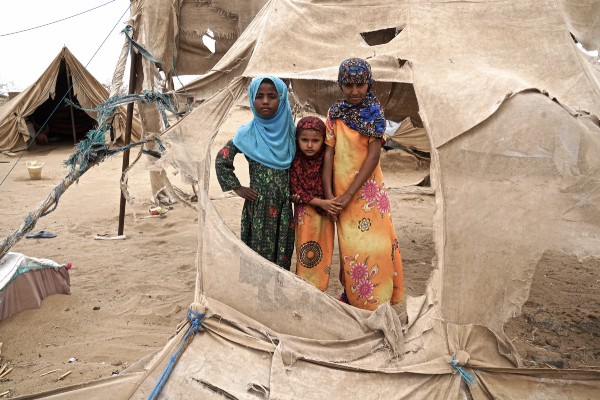
Above: A sandstorm approaches as residents of the Abs settlement for displaced persons collect water. 
Water is heavily rationed and only available during one-hour windows, three times a day.


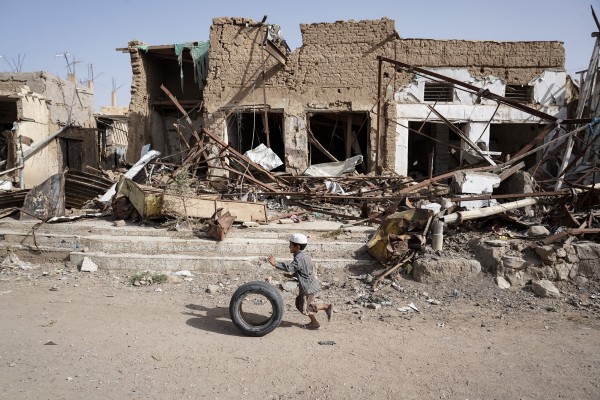
Even in the midst of destruction life goes on. 

Play 

School

Garbage piles up on the streets of Sana'a Old City 7 May, 2017

"My last day in Yemen was spent in Sana’a’s Al-Joumhouri Hospital, where the staff were frantically planning for the new cholera cases that had started flooding in. There were new suspected cases on gurneys in the corridors, while more urgent patients were being wheeled into already packed wards. We were shown the medical supply room in the basement, where a wall of boxes of saline and crates of bed covers were being ripped open for immediate use. Unbeknownst to me, this was the beginning of the largest global cholera outbreak in recent history."


(pictures above Sana’a’s Al-Joumhouri Hospital)

All images (C) Giles Clarke

To read the full story and see more images see medium.com

Giles Clarke is a Getty Images Reportage photographer who focuses on conflict aftermath and international humanitarian issues. To find out more about his work, click here