This week on Friday Round Up a review of the exhibition Mongolian Lens 1 curated by Jerry Galea and the opening of Andrew Chapman's Giving Life exhibition at Magnet Galleries Melbourne.
Review:
Mongolian Lens 1
Curated by Jerry Galea

(C) Otgonsuren: "Imagine relying on wood or coal-burning stoves for cooking and heating, with fuel costs eating up 40% of your income. Then imagine the discomfort of having to get up in the middle of the night when it's minus 35 C to go to the bathroom, outdoors. Worst of all, imagine you and your children breathing the thick, toxic smog from thousands of stoves everyday."
A criticism often levelled at documentary photography is that it tends to be western-centric where a photographer will enter a community and capture it from an outsider’s perspective.
One of the things that is so refreshing about the collection of images that formed the exhibition Mongolian Lens 1 is that the vast majority have been taken by Mongolian documentary photographers who show the audience the issues they want to focus on within their own communities. While many of the tropes that appear in Mongolian Lens 1 – poverty, environmental pollution, industrialisation and substance abuse – are common subjects for documentarians, the view from the inside gives greater depth; these are issues the locals want to talk about rather than the emphasis being imposed or assumed.
While the capturing of images is today more straightforward and more accessible given there is no requirement for film, developing and printing, gaining exposure for work can prove problematic even for the most seasoned photographer let alone those on the margins of the industry.
The work in this exhibition would not have made it to the walls of Magnet Galleries in Melbourne without the commitment of Australian documentary photographer and academic Jerry Galea, whose PhD research centres on how Mongolian society is transforming in the wake of globalisation. Using the lens of documentary photography, Galea examines the cultural significance of the photograph in Mongolian society and how local documentary photographers are using the medium as a vehicle through which to understand their own story.
Above: Winter Horse Racing (C) Davaanyam Delgerjargal: "The Naadam festivals, particularly the horse racing, will certainly, always be my subject of shooting. For years, I took photos at the finishing line of horse racing...During the racing, lots of children fall down, often due to other people's wrongdoing. We, Mongolians - old and young - run to the winning horse to touch its sweat for luck. This creates such chaos that horses startle and rear. Often their child riders are tossed off as a result".
Above: Gold Rush (C) Ganzorig Lkhamsuren: "The Khuvsugul province is well-known for its natural beauty and Lake Khövsgöl is one of the country's major tourist attractions. The largest forest areas of Mongolia are located around and to the north of this lake...'Ninja miners' dig small unauthorised mines or pan for gold. They are so named because they carry the green bowls they use for panning on their backs...Locals say there are now around 5000 people attracted to the region by gold. Wild and untouched before only tsaatan (reindeer nomads or hunters) would travel this far".
Mongolian Lens 1 is an insightful, and engaging, exhibition that reveals a culture of great depth and complexity. These images enable us to move beyond the fascination of the ‘other’ because we are seeing through the eyes of locals. This view delivers a perspective that is rich with meaning. While there are images that are unique to this part of the world, there are universal themes also. This combination creates an immersive experience and for those with an inquisitive mind, it builds knowledge and fosters understanding.


Above: Rural Schools (C) Davaanyam Delgerjargal


Above: Fashion (C) Davaanyam Delgerjargal


Above: Ulaanbaatar Borders (C) Rentsendorj Bazarsukh: "At the edes of the capital, Ulaanbaatar, are the city's ger districts, where more than half of the capital's residents live without access to basic public services such as water, sewage and central heating. In 1989, 26.8% of Mongolia's population lived in Ulaanbaatar and by 2010 it was 45%... thousands of herders left the steppe for the ger districts building hasta - small fenced enclosures - and erecting gers and tin-roofed brick houses."

Above: Ger District (C) Khash Erdene
Mongolia is a fascinating country that is rapidly developing at the expense of many of its citizens. In these images we can see the rise of modern industry juxtaposed against a more ancient way of life and the struggle inhabitants have in trying to hold onto traditions that are dear to them. As progress continues apace more people are driven into the cities where new settlements lack basic services such as sanitation and fresh water and employment opportunities are slim. The environmental impact of progress can also be seen in the billowing towers of toxic smoke that choke cities and in the hillsides ravaged by mining. Yet it would be incorrect to assume all the images in this collection are focused on the negative. To the contrary, they show life in all its multiple truths. There are celebratory images, quiet family moments, and idiosyncratic portraits that convey the complexity of the human condition.

Above: Alcoholism (C) Injinaash Ing: "In Gobi Altai province, in the Biger district, children are checking to see if the drunk passed out in the middle of the steppe is someone they know."

Above: The Route the Forest (C) Davaanyam Delgerjargal: "The route to the forest is getting longer and longer. To collect wood for fires one needs to set off before light and get back well after dark".
Mongolian Lens 1 offers a contemplative view of modern life in a country that, beyond its borders, is still largely shrouded in mystery. The photographs that accompany this review are of my choosing and demonstrate the strong storytelling skills of the Mongolian documentary photographers. I look forward to following this project as it develops. To find out more visit
Jerry Galea's website.


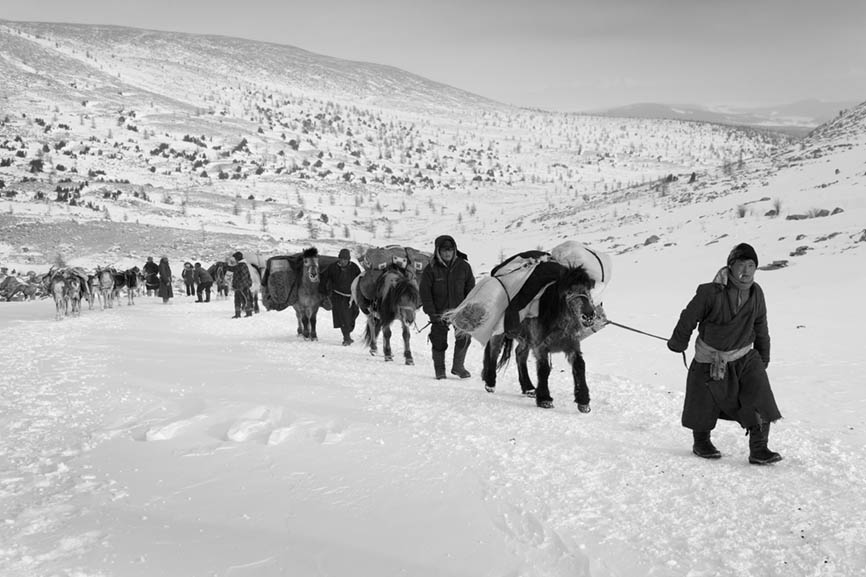
Above: From Jerry Galea's series A Wandering Life, the project which became the foundation and inspiration for his PhD research. "Early in the fieldwork I realised I had to take two distinct approaches to photography. For myself I wanted to work like a fly on the wall...(but) the photographs the nomads wanted me to take were very different. For them the photograph was an occasion, a formal event. My subjects carefully considered their clothing, chose their background and structured their pose; it was a reminder of a past when photographs were considered and a very formal event."

(C) Injinaash Ing: "On the Way to the Ovoo - in Bayankhongor province, in the Bogd district, we were taking the train with some lamas going to an Ovoo (dedicated to the holy one) worship ceremony. Ovoos are often found at the top of mountains and in high places like mountain passes. They serve mainly as Tengriism religious sites, used in the worship of the mountains and the sky as well as in Buddhist or Shamanist ceremonies, but often Ovoo are also landmarks. Almost all researchers say that originally all ovoo were made from holy woods, as well as rocks, and to this day they must include wooden elements."
End Note: This exhibition also featured a silent auction to raise funds for the Batzorig Foundation of Documentary Photography in Mongolia, which was named in honour of Tsevegmid Batzorig, a Gamma Agency pioneer Mongolian photographer who met an untimely death in the course of his documentary work in 2001. The money raised will fund a documentary project in Mongolia chosen by the Foundation. I’m excited to have been the successful bidder for "On the way to the Ovoo" (above).
Exhibition: Melbourne
Andrew Chapman - Giving Life

Award-winning Australian photojournalist Andrew Chapman knows firsthand what it's like to benefit from organ donation. Chapman received a liver transplant after being diagnosed with Haemochromatosis an inherited disorder in which iron levels in the body slowly build up over many years and destroy your liver. So when Donate Life Victoria asked him to shoot a series of pictures to promote Donate life Week (1st August) he didn't hesitate.
Shot at the Austin and Royal Victorian Eye and Ear Hospitals in Melbourne, Giving Life charts the pathway of organ transplant and it is hoped the exhibition, and publication of the images, will motivate people to register as an organ donor.


 (C) All images Andrew Chapman
Find out more at
Donate Life.
Opens this Sunday at 2.30pm
Exhibition runs 2-10 August
Level 2, 640 Bourke Street
Melbourne